How to Improve a Child’s Concentration
You’ve watched it a hundred times. The puzzle they begged for, abandoned before the lid comes off. The story they asked for, lost by the second page. The look on their face — and yours — when concentration slips away just when you both needed it to stay. Many children find it difficult to concentrate at different stages of development, and small, consistent changes can make a meaningful difference over time.
Long, focused attention isn’t something a child either has or doesn’t have. It’s built — through brain development, the right environment, and plenty of practice with activities that match where your child is right now. This guide walks through what concentration actually looks like at different ages, the everyday habits that grow it, the kinds of play that build it most effectively, and the small changes that often make the biggest difference.
Quick answer for busy parents. A child’s concentration improves when three things line up: a calm, low-clutter environment; an activity that is just challenging enough to be interesting but not overwhelming; and basic needs (sleep, food, movement, connection) being met. Most concentration struggles in childhood are a normal part of development and improve with consistent, small changes to environment, play and routine. This guide shows you exactly how.
If your child finds it hard to focus from time to time, that on its own is not a sign of ADHD or any other condition. Concentration is a skill that develops in fits and starts, and almost every child goes through phases where it wobbles. The strategies in this guide are for every parent — whether the difficulty is small and short-lived or something you would like extra support with.
Quick answer for parents, educators and professionals
Improving a child’s concentration is rarely about finding a single trick. It is about removing friction and adding the right kind of practice, day after day.
The most reliable approach combines five elements:
- Calm environment. Lower clutter, lower noise, fewer competing options.
- Right-fit activity. Something a little above the child’s current level — interesting, but not overwhelming.
- Strong foundations. Enough sleep, food, water, movement, connection and sensory regulation to support attention.
- Repetition. Short, frequent focus sessions build stamina faster than rare long ones.
- Warmth. A child who feels emotionally safe and seen learns to stay with hard things longer.
Use the rest of this guide as a toolbox. You don’t need to do everything at once — pick one or two changes from the relevant section and try them for a couple of weeks before adding more.
What concentration actually is
Concentration in childhood isn’t the same as adult focus. A three-year-old “concentrating” might mean staying with a stacking activity for two minutes. A six-year-old might sustain a board game for twenty. Both are genuine, valuable attention — and both are worth celebrating.
Researchers describe a small family of related skills that work together. Understanding them helps you pick the right support for the right difficulty:
| Component | What it means in everyday life | What supports it |
|---|---|---|
| Selective attention | Tuning in to one thing while ignoring distractions (e.g. listening to a story while siblings play). | Calmer spaces, predictable transitions, narrating what you’re doing. |
| Sustained attention | Staying with a task over time (e.g. finishing a puzzle or a chapter). | Right-fit difficulty, short sessions that build, taking a break before frustration. |
| Inhibition | Pausing before acting — putting a hand up, waiting a turn, resisting the urge to grab. | Games with rules, turn-taking, slow breathing, model-and-narrate. |
| Working memory | Holding information in mind long enough to use it (e.g. remembering three-step instructions). | Chunking instructions, memory games, songs and rhythms. |
| Cognitive flexibility | Switching between tasks or adjusting when something doesn’t work. | Open-ended play, gentle changes in routine, talking about feelings. |
Together these skills are often called executive function. They sit in the prefrontal cortex — the part of the brain that is still very much under construction in the early years and continues maturing into the early twenties. So when we talk about “improving concentration”, we are really talking about giving that part of the brain the conditions it needs to do its job: rest, repetition, play and connection.
For the broader developmental foundations behind this approach, see our guide to choosing toys that build real skills.
So how does this actually show up day to day? Knowing what to expect at your child’s age makes it much easier to tell the difference between a passing wobble and something worth a closer look. The chart below maps the typical shape of concentration from infancy through the early school years.
Realistic concentration by age (with chart)
Concentration grows in stages. The chart below is a guide, not a rule. These are approximate ranges, not milestones every child must reach, and children develop at very different rates. Interest, sleep, mood, sensory needs and environment can shift a child’s best focus by half an hour in either direction, and a child who is below the range on one activity can be well above it on another they love.
| Age band | Typical sustained focus on a preferred activity | Good first activities |
|---|---|---|
| 0–12 months | Seconds to ~2 minutes | High-contrast books, mirrors, soft sensory objects, peekaboo. |
| 1–3 years | 2–5 minutes | Stacking, sorting, simple puzzles, water play, songs with actions. |
| 3–5 years | 5–20 minutes | Puzzles, matching games, building sets, simple board games, drawing. |
| 5–8 years | 15–45 minutes | Logic puzzles, longer construction, chapter books, simple STEM kits. |
| 8+ years | 30–90+ minutes | Hobbies, complex kits, coding, music practice, longer reads. |
If your child’s focus on a preferred activity sits well below these ranges for several months, the when to seek support section below explains what to look for and who to talk to.
One important note: use the chart as a guide, not a yardstick. A child who sits below the range today can climb well above it in a few months with the right support, and a child who sits above it on a preferred activity may still struggle on tasks that don’t yet interest them. Both are completely normal.
Why children struggle to focus — and why it’s usually normal
Most concentration struggles in childhood are a normal part of development, not a sign that something is wrong. Some of the most common reasons a child finds it hard to focus include:
- Developmental readiness — the part of the brain that manages attention is still maturing well into childhood.
- Screen time habits — fast-paced digital content can train the brain to expect constant stimulation, making slower-paced activities feel boring by comparison.
- Sleep and hunger — tired or hungry children find it very hard to settle.
- Overstimulation — too many toys out at once, or a noisy environment, makes it hard to commit to one thing.
- Big feelings — anxiety, frustration or excitement can all pull attention away from a task.
- The activity itself — if a task is too easy, a child drifts; if it’s too hard, they give up.
- Transitions — switching between tasks uses real cognitive energy. Children who have just stopped a high-stimulation activity often need a runway to land.
Understanding why a child is struggling is often the first step in supporting them. The observation framework later in this guide gives you a simple way to figure out which of these is showing up most in your home.
A practical observation framework
Before changing toys, routines or rules, spend three days simply noticing. The point is to replace “Why can’t they focus?” with “What is happening in the moments when focus drops?” — because the second question is the one that leads to useful changes.
What to watch for
- When. What time of day? Before or after meals? Before or after screens, day-care, kinder or school?
- Where. In the playroom? At the kitchen table? In the car? In bed?
- With what. Which toy, task or screen — and is it usually the same?
- With whom. Alone, with a sibling, with you, with other children?
- Body signals. Fidgeting, yawning, red ears, big movements, going quiet, getting silly.
- Recovery. What helps them re-engage — a snack, a walk, a cuddle, a change of scene?
A simple weekly log
You don’t need a formal chart. A small notebook or a notes-app entry each evening is enough. Try this format for a week:
| Day | Hardest moment for focus | What was happening just before | What helped |
|---|---|---|---|
| Mon | 4 pm — refused puzzle, threw pieces | Straight from day-care, no snack | Snack + 10 min outside, then puzzle |
| Tue | … | … | … |
After a week, look for patterns. Most families find one or two clear triggers — and one or two clear helpers — that they hadn’t consciously noticed before.
One important note: the goal of this kind of observation is to spot patterns so you can support your child better at home and in conversation with educators. It is not a tool for diagnosing developmental conditions. If the patterns you see are concerning, persistent or affecting daily life, the right next step is to talk to your GP or a child health professional — not to draw conclusions from the log alone.
The foundations: sleep, movement, food, connection and sensory load
Concentration sits on top of basic needs. If those needs aren’t met, no toy, app or technique will stick for long.
Sleep
Sleep is when the brain consolidates everything it learned during the day, including attention skills. Australian sleep recommendations from Raising Children Network Australia suggest 11–14 hours per day for toddlers (including naps), 10–13 hours for preschoolers and 9–11 hours for school-age children. A consistent bedtime routine — bath, story, lights down — protects this more than any “sleep training” method.
Movement
The World Health Organization recommends at least 180 minutes of physical activity per day for children under five, and at least 60 minutes of moderate-to-vigorous activity per day for school-age children. Movement before a focused task — even 10 minutes outside — reliably improves attention. After long stretches of sitting, the body often needs to move before it can settle again.
Food and hydration
Regular meals and snacks with protein, healthy fats and slow-release carbohydrates stabilise energy and mood. A glass of water and a small protein-rich snack 20 minutes before homework or a learning activity can change the entire session.
Connection
A child who feels emotionally safe learns to stay with hard things longer. Five minutes of one-on-one attention before a focus task — a chat, a cuddle, a quick game — often outperforms any other single intervention.
Sensory load
Background noise, bright lights, scratchy clothing, hunger, strong smells — all of these use up the same attention system a child needs for learning. Reducing sensory load is one of the fastest, cheapest ways to free up concentration.
The best environment for focus at home
Before reaching for new toys or techniques, look at the space. A few small changes to the environment can dramatically improve a child’s ability to settle:
- Rotate, don’t pile. Keep a smaller number of toys accessible at a time, and rotate them weekly. Fewer choices mean longer attention.
- Create a “yes space”. A low shelf, basket or tray where children can independently choose a focused activity builds autonomy and engagement.
- Reduce background noise. Constant TV or music in the background makes concentration harder, even when your child “isn’t really watching”.
- Use natural light and a calm corner. Soft lighting and a dedicated quiet area signal to the brain that it’s time to slow down.
- Protect the transition. Five-minute warnings before switching activities help children prepare mentally to finish what they’re doing.
- Sit to focus, not to lounge. A small table and chair, or a wobble cushion on the floor, beats the deep couch for tasks that require thinking.
Think of the environment as the foundation — the rest of the work builds on top of it.
Classroom and educator strategies
Educators face a different challenge: shared space, mixed ages, varied sensory needs and a fixed curriculum. The principles above translate well — the tactics just look slightly different. The strategies below are starting points, not rules: they should always be adapted to the individual child, because no single approach works for every learner.
- Chunk the session. 5–10 minutes of focused input followed by a 2-minute movement break is much more efficient than 25 minutes straight.
- Pre-teach transitions. Visual timers (“when the sand runs out, we clean up”) give children an internal clock rather than relying on adult prompts.
- Offer choice within structure. “Choose the red book or the blue book” keeps autonomy without overwhelming the planning system.
- Use fidget-friendly seating. For children who regulate through movement, a wobble cushion, therapy ball or floor spot can sustain attention that a chair alone cannot.
- Narrate attention. “I notice Sienna is really sticking with that puzzle — that’s concentration growing.” Naming the skill makes it visible and valued.
- Communicate with families. When home and school share what they’re seeing, patterns become visible much faster than either can spot alone.
For educators exploring sensory and movement supports in more depth, our complete guide to sensory tools for calm and focus covers the topic in detail.
Homework, reading and multi-step tasks
Homework is where most concentration struggles show up in school-age families — and where the gap between “can focus on a preferred activity” and “can focus on a required activity” becomes visible. A few practical strategies help:
Set the stage
- Same time, same place, same routine. Predictability reduces the mental cost of starting.
- Have everything ready before you call your child. Pencils, books, water, snack.
- Phones, tablets and TVs off and out of sight — including the parent’s.
Make the task smaller than it looks
- “Do one page” rather than “do your homework”.
- Use a visual checklist: reading → question 1 → question 2 → pack the bag.
- Break reading into short rounds with a quick retell between pages.
Use the body to help the brain
- Stand up to read aloud, walk and talk through tricky sums, or sit on a wobble cushion.
- Keep a small fidget tool at the table — magnetic rings or a pop tube work well.
- A five-minute movement break every 15–20 minutes prevents the crash.
End on a high
End on a high. Stop before frustration hits. Tomorrow's homework goes better when today's ended with your child feeling capable. Children build concentration far more readily when they regularly experience success and enjoyment, not only challenge — so finishing on a small win matters more than finishing the whole page.
Screen time, attention and what the research says
Research suggests that high levels of fast-paced recreational screen content may make it more difficult for some young children to sustain attention during slower-paced activities. The American Academy of Pediatrics and Raising Children Network Australia both recommend limiting recreational screen time and choosing slow, calm content when screens are used.
This doesn’t mean screens are the enemy. It means the type and amount matter enormously. A nature documentary or a slow-paced story is a very different experience to a rapid-fire cartoon full of cuts every two seconds. For a deeper look at the science — and a clear breakdown of age-appropriate screen-time guidelines for Australian families — see our complete guide to screen time and child development.
One of the most effective swaps families make is replacing some passive screen time with hands-on, open-ended play — the kind where the child is in charge of what happens next.
The power of open-ended, hands-on play
Open-ended play is one of the most valuable ways to support the development of concentration, problem-solving and independent thinking. Unlike a toy with one correct answer or one specific outcome, an open-ended toy can be played with in many different ways — and that freedom is exactly what holds a child’s attention.
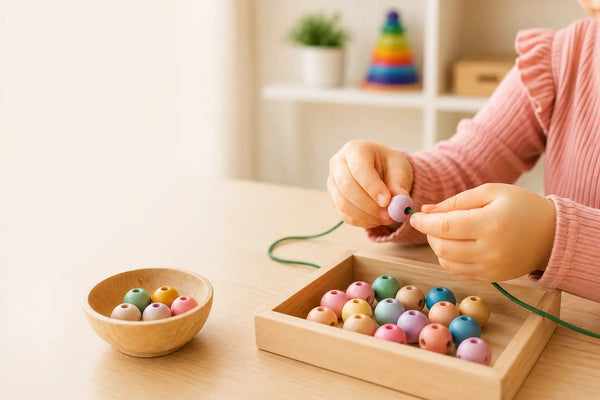
One of the richest forms of open-ended play for building sustained attention is fine motor work — the small, precise hand movements that quietly demand focus as the child threads, stacks, cuts and constructs. For a complete, age-by-age guide to the activities that build these skills, see our complete guide to fine motor activities for kids.
When a child decides how to play, they engage deeper planning, problem-solving and creativity. That deeper engagement may help children sustain attention for longer over time through repeated practice. To understand the developmental principles behind this approach, see our guide to how Montessori toys help children learn through play.
WonderMinds Kids specialises in this kind of play. A few standout choices:
- Magnetic Tiles Building Set — open-ended construction that absorbs children for long stretches.
- Montessori Rainbow Play System — a beautifully versatile set for stacking, building, sorting and imaginary play.
- Wooden Rainbow Semi-Circles — simple shapes that invite complex thinking.
Browse the full games and puzzles collection for more options across age groups, or explore our open-ended play collection for materials designed to grow with your child.
Puzzles, mazes and logic games
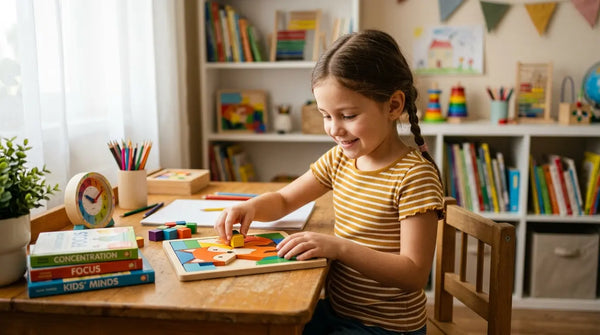
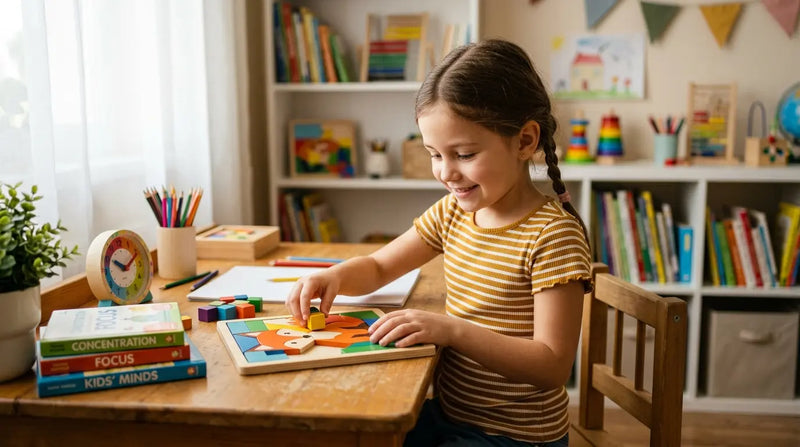
Puzzles are the classic concentration-builder for a reason: they’re self-correcting, they reward persistence and they grow with your child. A 12-piece jigsaw teaches sequencing and shape recognition. A 100-piece jigsaw with a favourite theme can hold an older child for an hour.
Logic games extend that focus with an extra layer of planning:
- Montessori Magnetic Maze Board — children move a magnetic bead through the maze, building planning and hand–eye coordination.
- MindCraft Wooden Logic Cube — a 3D brain teaser that rewards careful thinking.
- 3D Brain Teaser Puzzle — spatial reasoning for older children and family play.
- Tetra Tower Balance Stacking Game — a family strategy game that asks for steady hands and steady minds.
For a deeper dive, our puzzles collection gathers wooden, 3D and logic puzzles by age.
Sensory play and fidget tools for calmer focus
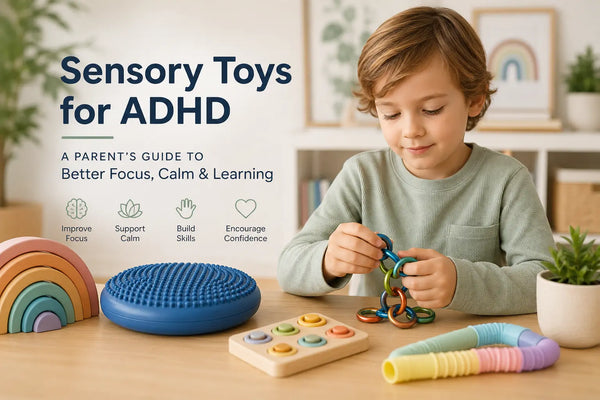
Many children, particularly those who benefit from sensory input, find it easier to concentrate when their hands are engaged in purposeful movement. Sensory and fidget toys provide just enough movement to help the body settle, freeing the mind to focus on a task. If you’re still figuring out the why behind your child’s constant movement, our guide to why some children can’t sit still walks through the developmental reasons — and what helps.
This isn’t about “fidgeting” being a problem to fix. It’s about recognising that some children’s brains regulate through movement, and giving them appropriate tools to do so.
- Sensory Activity Fidget Board — a quiet, portable tool for calm focus at the table or in the car.
- WonderCalm Magnetic Rings — clickable, stackable and easy to keep in a pocket or bag.
- WonderCalm Pop Tubes — a classic pop-and-connect sensory tool for travelling and waiting rooms.
- Sensory Wobble Cushion — encourages active sitting and may help some children remain engaged during seated activities like drawing or homework.
- Steering Wheel Busy Board — great for imaginative, hands-on play that builds focus through pretend play.
For a deeper look at how sensory tools support focus and calm — and which specific toys are best at each age — see our complete guide to sensory toys for calm and focus. Or browse the sensory toys collection for more options, including tools for quiet time and travel.
Building focus through daily routines
Concentration is strengthened by the rhythms of everyday life, not just by toys. A few small habits make a meaningful difference over time:
- Protect sleep. Sleep plays an important role in consolidating learning and memory, including the skills involved in attention.
- Feed the brain well. Regular protein, healthy fats and slow-release carbohydrates help stabilise energy and mood.
- Move the body first. Outdoor play, climbing, balancing and running help children arrive at focused activities more settled.
- Read together every day. Even 10 minutes of shared reading each day builds the attention span needed for longer books later.
- Protect unstructured play. Unstructured time is where children learn to entertain themselves — and self-directed play is the deepest kind of focus.
None of these are quick fixes. Together, they are the slow, steady conditions in which concentration grows.
A sample daily rhythm for focus
| Window | What happens | Why it helps focus |
|---|---|---|
| Morning | Protein-rich breakfast, 15–30 minutes outside, predictable transition to school/kinder. | Stable blood sugar and nervous-system regulation. |
| After school | Snack, free play outside, then a 10-minute connection moment before homework. | Discharges the “school day” and resets attention. |
| Homework window | Short, chunked tasks with movement breaks every 15–20 minutes. | Matches the working memory window of a tired child. |
| Evening | Calm activities, bath, story, screens off 60 minutes before bed. | Protects the sleep that protects attention. |
Concentration action plans by age
The age bands below use the same realistic expectations as the chart earlier, but turn them into concrete, week-by-week starting points. Pick one or two to try first; don’t try to change everything at once.
Babies (0–12 months)
Attention is fleeting and that’s exactly right. Use high-contrast books, simple sensory toys and short floor-time play. Mirrors and soft textured objects like the Tummy Time Discovery Mirror Book are perfect for this stage.
This week, try: a daily two-minute “looking time” with one high-contrast toy; narrating what you’re doing in short sentences; and a calm, predictable pre-nap routine.
Toddlers (1–3 years)
Expect 2–5 minute focused play sessions. Sorting, stacking and simple puzzles are ideal. Try the KoalaSense Baby Stacking Tower or the Montessori Music Table.
This week, try: rotating toys down to 4–6 choices; offering one “work” mat where a single activity lives; and a five-minute “together” book before nap.
Preschoolers (3–5 years)
Focus stretches to 5–20 minutes with the right activity. This is the prime age for puzzles, matching games and construction toys. The Wooden Matching Puzzles and Wooden Shape & Colour Sorting Toy are standout choices.
This week, try: a 15-minute “quiet time” each afternoon; one new puzzle added each week at the right level; and ending every activity on a high before frustration.
Early school age (5–8 years)
Children can sustain 15–45 minutes of focused activity. Logic puzzles, STEM kits and longer construction projects shine here. Try the Magnetic Balls & Rods Set or the MagnetiCube Builder.
This week, try: the chunked homework routine from the section above; a daily 10-minute independent reading window; and a visual checklist for getting ready in the morning.
Older children (8+)
Focus extends further, but interest becomes the deciding factor. Hobbies, complex building kits and science tools work beautifully. The Pocket Discovery Microscope or the 3D Pen Kit can capture a curious mind for hours.
This week, try: teaching one specific focus skill (pomodoro, two-finger stop-check, reading-with-questions); a hobby window protected from interruptions; and a weekly reflection on what worked.
Neurodiversity-affirming adaptations
Some children’s brains process the world differently — and that is not a problem to be fixed. Small adaptations to environment and expectation make an enormous difference.
ADHD
Children with ADHD often concentrate brilliantly on preferred activities but struggle with tasks that aren’t stimulating. External structure — visual schedules, timers, chunked tasks, movement breaks — supports the brain without fighting it. Our guide to helping a child with ADHD focus naturally and the sensory guide for calm and focus are written for this exact pattern. For an Australian-specific resource, ADHD Australia maintains current guidance and referral pathways.
Autism
Many autistic children concentrate deeply on preferred interests — that focus is a strength, not a deficit. Building new skills by linking them to existing interests, honouring sensory preferences (lighting, sound, texture), and using predictable routines are reliable supports. Autism Spectrum Australia (Aspect) provides Australian-specific resources and advice.
Anxiety
Anxious children often struggle to focus because part of their brain is monitoring for threat. Calming the nervous system first — co-regulation, predictable transitions, naming the worry — frees attention for the task. Beyond Blue offers Australian-specific guidance for families.
Learning differences
Dyslexia, dysgraphia, dyscalculia and other specific learning differences affect how children take in and express information. Identifying the right support through your school or a psychologist changes the trajectory. The Australian Psychological Society maintains a national Find a Psychologist directory that can help families connect with practitioners experienced in learning and attention.
Throughout, the guiding principle is the same: meet the brain where it is, not where we wish it were.
Troubleshooting matrix: pattern → likely contributors → first steps
When focus drops, the cause usually lives in one of a few places. Use this matrix as a starting point, not a diagnosis.
| You notice | Likely contributors | First steps to try |
|---|---|---|
| Focus crashes after lunch or late afternoon | Low blood sugar, dehydration, natural circadian dip | Protein-rich snack, water, 10 minutes outside; save harder tasks for the morning. |
| Can focus on screens for hours but not on toys | Highly stimulating screen content can make slower-paced activities feel less immediately rewarding | Reduce fast-paced content first; introduce one hands-on activity 30 minutes after screen time ends. |
| Focuses at kindergarten but not at home | External structure at school, no structure at home | Add a visual routine at home; try a wobble cushion or defined “work spot”. |
| Starts tasks but never finishes | Task too big, working memory overload, transition difficulty | Chunk into smaller steps; use a visual checklist; praise finishing one step. |
| Big emotional reactions to being asked to focus | Anxiety, sensory overload, frustration masking another skill gap | Pause and co-regulate first; lower the demand; check for sensory triggers. |
| Focus fine on preferred topics, poor elsewhere | Interest-driven attention; possible ADHD pattern | Bridge preferred interests into harder tasks; see our natural-focus strategies for ADHD. |
| Focus worse after a difficult week at school | Emotional load, friendship stress, sensory exhaustion | Lower the bar for a few days; prioritise connection over productivity. |
| Constant body movement, can't sit still | Sensory regulation needs; movement helps the body settle | Allow movement before focus; try a wobble cushion or fidget tool; read our can't-sit-still guide. *(links to /blogs/parenting/why-cant-my-child-sit-still)* |
If two or more rows fit consistently over weeks, the next section describes when and how to bring it to a professional.
Common mistakes parents make when trying to build focus
A few patterns come up again and again in our conversations with Australian families. None of them are “wrong”, but each one can quietly work against the goal:
Too many toys out at once
Choice overload is real for adults and even more so for children. The more options available, the harder it is to commit to any one. Rotating toys every week or two is a small change with a big impact.
Correcting instead of narrating
When a child loses focus, it’s tempting to say “pay attention!” or “why aren’t you listening?”. Narrating what’s happening — “I notice you’re finding it hard to sit still right now” — invites the child to reflect without shame, and the reflective skill is what they’re really building.
Forcing longer focus than the child can manage
Expecting a four-year-old to sit still for 30 minutes usually backfires. End on a high note, before the child has had enough, and the activity stays positive next time.
Reaching for screens to "reset"
Screens can feel like an easy reset, but the fast stimulation they provide can make slower activities feel even harder when you come back to them. A quiet fidget toy or a short walk often works better.
Comparing to other children
Every child develops on their own timeline. Comparing your child’s focus to a sibling’s or a friend’s is rarely useful and often adds stress that makes focus even harder.
Treating attention as a personality trait
“She just can’t focus” becomes a story the child internalises. Attention is a skill, built in the right conditions, and the story we tell matters.
How to track progress without comparison
Tracking helps you see what’s working — but only if it doesn’t turn into a scoreboard. The goal is to notice growth, not to outperform a sibling, a friend or last week’s version of your child.
A simple weekly check-in
Pick one or two things to observe, not everything. For example:
- “Longest single focus session on a preferred activity this week.”
- “Number of times I caught myself narrating instead of correcting.”
- “Did the new routine make mornings calmer?”
What good progress looks like
- One or two minutes longer on a preferred activity after a few weeks.
- Less emotional fallout when a task ends.
- Quicker re-engagement after a distraction.
- More willingness to try a slightly harder activity.
What not to measure
- Screens avoided (encourage, don't police).
- Minutes spent sitting still (sitting is not the goal).
- Performance against another child.
What should I try first?
If this guide feels like a lot, start here. These five small changes cover the highest-leverage moves for most families. Pick one or two to begin with, run them for two to three weeks, and only then add the next.
- Reduce the number of toys available.
- Create one calm play space.
- Protect sleep and daily routines.
- Spend 10 minutes each day following your child's lead in play.
- Try one concentration-building activity consistently for two weeks before introducing another change.
When (and how) to seek extra support
Most children go through phases of distractibility, and most of those phases pass. Some signs that it might be worth speaking to a professional include:
- Concentration difficulties that are getting in the way of learning, friendships or daily life.
- Big differences in attention between home and another setting (like preschool or school).
- Difficulties that have been consistent for many months, not just a difficult week.
- Strong emotional reactions to being asked to focus, beyond what’s typical for the age.
- Concentration difficulties alongside big shifts in sleep, mood or anxiety.
A practical first step
Your GP is the right starting point in Australia. They can talk through what you’re seeing, rule out things like hearing, vision or sleep issues, and guide you towards:
- Paediatricians — for developmental and medical assessment.
- Psychologists — for learning, attention, emotional and behavioural assessment.
- Occupational therapists — for sensory, motor and self-regulation support.
- Speech pathologists — when language or processing is part of the picture.
- School supports — classroom adjustments, learning support teams and school counsellors.
Reaching out isn’t a sign of failure — it’s a way of getting the right support early. For an Australian starting point, the Raising Children Network maintains up-to-date guidance on referral pathways by state and territory.
Frequently asked questions
References and further reading
Editorial note: This article is intended for educational purposes only and should not be considered medical advice. If you have concerns about your child's development, attention or learning, please speak with your GP or another qualified health professional.
- Raising Children Network Australia — Australian Government-funded parenting resource on child development, attention, screen time and referral pathways.
- American Academy of Pediatrics (AAP) — guidelines on screen time, play and healthy child development.
- Harvard Center on the Developing Child — research on executive function, attention and the developing brain.
- Centers for Disease Control and Prevention (CDC) — developmental milestones and child development resources.
- National Association for the Education of Young Children (NAEYC) — research and resources on early childhood education and play-based learning.
- World Health Organization (WHO) — physical activity guidelines for children under five and their link to healthy development.
- NHS — Children and young people’s mental health — UK guidance on emotional wellbeing, anxiety and attention in childhood.
- CHADD (Children and Adults with ADHD) — evidence-based resources on ADHD, attention and learning.
- Australian Government Department of Health — Australian children’s health, developmental milestones and physical activity guidance.
- ADHD Australia — Australian ADHD advocacy, education and referral pathways.
- Autism Spectrum Australia (Aspect) — Australian autism resources and advice for families.
- Beyond Blue — Australian guidance on children’s anxiety, emotional wellbeing and family support.
Final thoughts
Improving a child’s concentration isn’t about working harder — it’s about working with how children’s brains actually develop. Small, consistent changes to the environment, the daily routine and the kinds of play you offer will do far more than any single “miracle” toy ever could.
Meet your child where they are. Celebrate the small wins. Keep most of the day slow, hands-on and connected. And trust that, given the right conditions, focus grows — one beautifully absorbed minute at a time.
Every puzzle completed, every tower rebuilt, every story finished and every moment of uninterrupted play is another small step in your child's lifelong ability to learn, think and thrive.