What Toys Make Kids Smarter? A Parent's Guide to Choosing Toys That Build Real Skills
You're standing in the toy aisle, or scrolling online at midnight, and the question quietly arrives.
"What toys actually make my child smarter?"
It's one of the most common questions parents ask. It's also one of the most misunderstood.
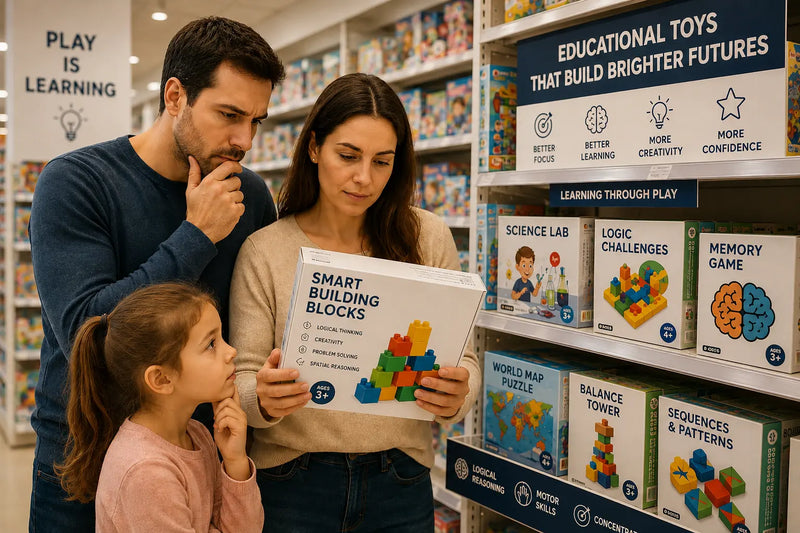
The shelves are filled with boxes claiming to boost IQ, raise test scores, or give your child a "head start." Some promise to make your toddler read by age three. Others suggest your preschooler will master maths before they start school.
If you've ever felt overwhelmed by these claims, you're not alone.
The truth is far more reassuring. There is no single toy that makes children smarter. Research consistently shows that intelligence isn't built by flashcards, gadgets or "smart" electronics. It's built through everyday experiences — most of all, through hands-on, playful exploration of the world.
The right toys don't pump information into your child's brain. They invite children to think, move, create, solve problems and engage their senses. In doing so, they help build the foundations for lifelong learning.
This guide walks you through what child development research actually says, the categories of toys that genuinely build skills, and how to choose toys that suit your child's age, interests and stage of growth — without the marketing hype.
Quick Answer: What Toys Make Kids Smarter?
The toys most likely to support healthy brain development are open-ended, hands-on and developmentally appropriate. These include wooden building toys, puzzles, sensory materials, pretend play sets, art supplies, musical instruments, balance and movement toys, and simple logic games.
What makes them powerful isn't flashing lights or screen-based programming. It's that they invite children to actively think, create and problem-solve rather than passively watch. Research shows that hands-on, child-led play strengthens the executive functioning, language, motor and social-emotional skills that underpin long-term learning.
Throughout this guide, you'll find links to toys from the Wonder Minds Kids toy range that support each of these skill areas.
Why "Smart" Toys Are Mostly Marketing
Before talking about what does help children learn, it's worth naming what doesn't.
Walk through any toy shop and you'll find products claiming to:
- "Boost IQ by 30%"
- "Make your baby a genius"
- "Teach reading before age three"
- "Replace screen time entirely"
- "Endorsed by neuroscientists"
Most of these claims aren't supported by independent research. Many come from the toy companies themselves, or from small studies funded by those same companies.
Over the past decade, academic reviews of "smart" toys — particularly electronic and screen-based products marketed as educational — have repeatedly found that the marketing far outpaces the evidence.
This doesn't mean electronic toys are always harmful. It means the label "educational" tells you very little on its own.
What does matter is how a toy is used, whether it matches your child's developmental stage, and — most importantly — whether it invites active thinking or passive consumption.
A toy that's played with actively, in many different ways, over a long period of time, will almost always be more "educational" than a flashy gadget that's used for a week and forgotten.
What "Smarter" Actually Means in Child Development
When parents ask what toys make kids smarter, they often imagine academic skills — letters, numbers, reading.
But child development researchers describe intelligence much more broadly.
Across decades of research, the skills most strongly linked to long-term learning and wellbeing fall into a handful of categories:
- Executive functioning — the ability to focus, plan, remember instructions and control impulses.
- Language and communication — vocabulary, storytelling, conversation, listening.
- Problem-solving and reasoning — figuring out how things work, testing ideas, adjusting strategies.
- Fine motor skills — the small hand movements needed for writing, dressing, eating and self-care.
- Gross motor skills — coordination, balance, strength and body awareness.
- Social-emotional skills — empathy, emotional regulation, cooperation, confidence.
- Creativity and imagination — the ability to invent, combine ideas and think in new ways.
- Sensory processing — how the brain organises information from the senses.
These are the foundations of lifelong learning. They're also the skills that play builds most naturally.
A toy is "smart" when it helps develop one or more of these skills — and when it does so in a way that feels like play to your child.
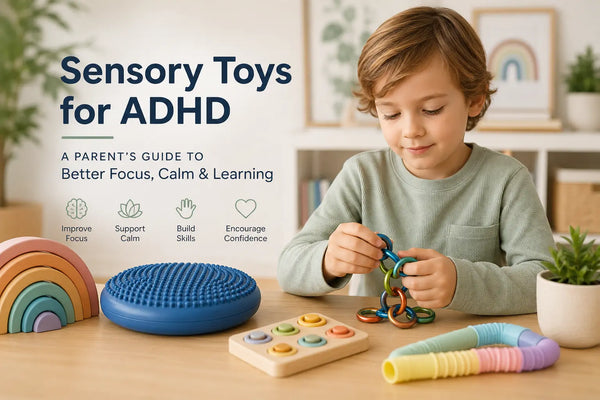
For children with ADHD, sensory processing is often the specific lever that most affects focus and self-regulation. Our sensory toys for ADHD guide walks through the evidence base, age-by-age picks, and a sensory diet framework.
The Science: Why Play Builds Smarter Kids
Play isn't a break from learning. For young children, play is learning.
This idea sits at the heart of child development research, and it's the reason educators from Reggio Emilia to Montessori to Steiner have built entire early-years philosophies around it.
When children play — particularly open-ended, hands-on play — several important things happen in the brain.
1. The brain forms connections through experience
Every time a child touches, manipulates, builds, balances or creates, neural pathways in the brain strengthen. The phrase "neurons that fire together wire together" describes this beautifully.
The more variety and repetition a child gets, the richer their brain networks become.
2. Hands engage the mind
Research from the University of Washington and others has shown that hands-on activity activates multiple regions of the brain at once — including those responsible for language, memory, spatial reasoning and problem-solving.
When children physically manipulate objects — turning, fitting, stacking, threading — they're not just playing. They're building the brain.
3. Movement supports thinking
Children don't sit still to think. They move, fidget, climb and explore. This isn't a behaviour problem — it's how the brain organises itself.
Movement improves attention, working memory and emotional regulation, particularly in young children. For the developmental and sensory reasons behind this connection, explore our guide to why children need to move to learn.
4. Open-ended play builds executive functioning
Open-ended toys — those that can be used in many different ways — give children opportunities to plan, make decisions, adapt strategies and solve problems. These are exactly the skills measured by executive functioning tests.
Closed-ended toys, where there's only one right answer or outcome, offer much less of this brain-building variety.
5. Pretend play strengthens social-emotional skills
When children play "mum and dad," "shop," or "doctor," they're rehearsing real-life social scenarios. Pretend play has been linked to stronger emotional regulation, empathy and language development.
The 8 Categories of Toys That Genuinely Build Skills
Rather than searching for a "smart toy," it's far more useful to choose toys that support specific developmental skills.
Below are the eight categories most strongly supported by research, with examples drawn from our educational toy range.
1. Open-Ended Building Toys
Building toys are among the most researched developmental tools. Wooden blocks, magnetic tiles, stackers and construction sets invite children to imagine, design, test and rebuild.
What they build:
- Spatial reasoning
- Problem-solving
- Fine motor control
- Planning and sequencing
- Creativity and persistence
Open-ended building toys have no single "right" outcome. A child can build a tower, a bridge, a castle or something entirely invented. Each session builds different parts of the brain.
Examples we love:
- Magnetic Tiles Building Set — endless 2D and 3D constructions.
- Wooden Rainbow Semi-Circles — beautiful loose-parts play.
- Magnetic Balls and Rods Set — for older builders.
- Montessori 3D Wooden Puzzle — combines building with spatial reasoning.
2. Puzzles and Logic Games
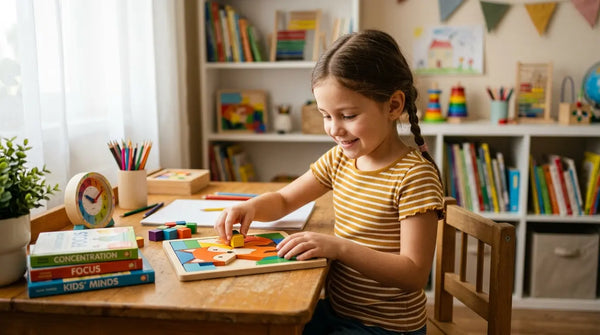
Puzzles are one of the simplest and most powerful learning tools available. They teach persistence, shape recognition, planning and problem-solving.
What they build:
- Visual-spatial reasoning
- Working memory
- Logical thinking
- Patience and frustration tolerance
Logic puzzles take this further. They introduce sequencing, cause-and-effect and early engineering thinking in a way that feels like play.
Examples we love:
- MindCraft Wooden Logic Cube — strategy and reasoning in a small, durable format.
- 3D Brain Teaser Puzzle — challenges spatial thinking.
- Wooden Matching Puzzles — perfect for early learners.
- Tetra Tower Balance Stacking Game — family-friendly strategy.
3. Sensory Play Toys
Sensory play supports the brain's ability to process and organise information from the senses. It's particularly valuable for young children, and for any child who finds attention, regulation or transitions difficult.
What it builds:
- Sensory processing
- Emotional regulation
- Focus and attention
- Fine motor skills
- Calm and self-soothing
Sensory play doesn't need to be complicated. It can be as simple as running hands through dry rice, manipulating fidget toys, or exploring different textures.
Examples we love:
- Sensory and Focus Play collection — fidgets, spinners and tactile toys.
- Sensory Activity Fidget Board — engages busy hands.
- Montessori Sensory Soft Balls — early tactile exploration.
- Sensory Wobble Cushion — supports calm, focused sitting.
4. Pretend Play and Role-Play Toys
When children play "shop," "kitchen," "school" or "vet," they're not just having fun. They're rehearsing the social and emotional scripts of everyday life.
Pretend play builds:
- Language and vocabulary
- Social skills and cooperation
- Emotional understanding
- Storytelling and sequencing
- Imagination
Open-ended pretend play sets last far longer than scripted toys because children create the narrative themselves.
Examples we love:
- Wooden Ice Cream Shop Counter — rich role-play with maths opportunities.
- Birthday Cake Pretend Play Set — encourages storytelling.
- Little Chef Kitchen Utensils Set — for everyday role-play.
- Montessori Farm Animal Set — combines storytelling with sorting.
5. Fine Motor and Manipulative Toys
Fine motor skills — the small, precise movements of the fingers and hands — are essential for writing, dressing, eating, drawing and self-care. They're also the foundation of early academic skills.
For a deep dive into fine motor development by age — including the building-block sequence, age-by-age milestones, household and classroom activities, and when to seek professional support — see our complete guide to fine motor skills activities.
These toys build:
- Pincer grip
- Hand strength
- Hand-eye coordination
- Bilateral coordination
- Concentration
Examples we love:
- Wooden Shape and Colour Sorting Toy — combines sorting with fine motor work.
- Magnetic Colour Sorting Game — quiet, focused play.
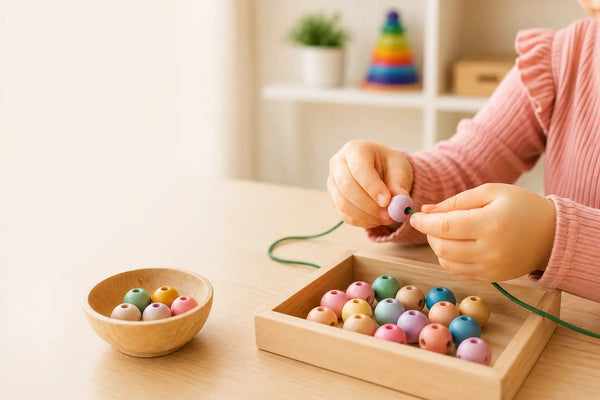
- Montessori Lacing Beads and Seesaw — threading and balancing.
- Montessori Magnetic Maze Board — pencil grip preparation.
6. Balance, Movement and Gross Motor Toys
The brain doesn't develop in isolation from the body. Movement is one of the most powerful ways young children build neural pathways for attention, coordination and emotional regulation.
These toys build:
- Balance and coordination
- Body awareness
- Strength and posture
- Self-regulation through vestibular input
- Confidence
Examples we love:
- Montessori Balance Stepping Stones — active play indoors and out.
- Sensory Balance Path Stones — great for obstacle courses.
- Montessori Climbing Arch — supports whole-body development.
- Wooden Bowling Set — turn-taking and coordination.
7. Early Maths and Numeracy Toys
Children develop early maths concepts naturally through play long before they encounter formal numbers. Sorting, counting, patterning and comparing are the foundations of mathematical thinking.
These toys build:
- Number sense
- Pattern recognition
- Counting and one-to-one correspondence
- Sorting and classifying
- Logical reasoning
Examples we love:
- Wooden Stacking Number Puzzle — combines counting with stacking.
- Colour Matching and Counting Game — playful early maths.
- Montessori Smart Math Board — early numeracy through play.
- Montessori Matching Eggs — shape and pattern matching.
8. Music, Rhythm and Sound Toys
Music supports language development, memory, pattern recognition and emotional expression. Even simple instruments give children rich learning opportunities.
These toys build:
- Rhythm and timing
- Auditory discrimination
- Language and vocabulary
- Self-expression and confidence
- Pattern recognition
Examples we love:
- Montessori Music Table — interactive musical play.
- Interactive Learning Owl Toy — combines music with early learning.
Choosing Toys by Age: What Skills Matter Most?
Different skills develop at different stages. Choosing toys that match your child's developmental window helps them thrive without frustration.
0–12 Months: Sensory Exploration
Babies learn about the world through their senses. The best toys at this stage offer different textures, sounds and safe opportunities for exploration.
Look for:
- High-contrast visuals
- Soft, varied textures
- Safe grasping and mouthing
- Cause-and-effect responses
Try:
1–3 Years: Movement, Language and Discovery
Toddlers are constantly on the move and absorbing language rapidly. The best toys support gross motor development, early vocabulary and simple problem-solving.
Look for:
- Stacking, nesting and sorting
- Pretend play invitations
- Push-and-pull toys
- Simple puzzles with knobs
Try:
- Koala Baby Stacking Tower
- Montessori Spinning Rainbow Tower
- Montessori Quiet Book
- Sensory and Developmental Play Gym
3–5 Years: Problem-Solving and Imagination
Preschoolers are developing independence, complex language and the early foundations of logical thinking. Open-ended toys shine here.
Look for:
- Building sets with multiple pieces
- Imaginative role-play props
- Logic puzzles and matching games
- Art and craft materials
Try:
- Montessori Rainbow Play System
- Ultimate Montessori Busy Book
- Bear Family Dress Up Puzzle
- Artisan Mindful Wooden Puzzle
5–8 Years: STEM, Strategy and Skill-Building
School-aged children benefit from toys that introduce more complex reasoning, planning and creative challenges.
Look for:
- Construction and engineering kits
- Strategy board games
- Creative STEM tools
- Independent project toys
Try:
- STEM and Engineering collection
- WonderWorks 4WD Engineering Car Kit
- 3D Pen Kit for Kids
- Montessori Geometric Nail Board Set
What to Look for When Choosing "Smart" Toys
Most toys can be educational in the right context. The key is knowing what to look for.
Open-ended vs closed-ended
Open-ended toys can be played with in many different ways. A wooden block can become a tower, a bridge, a phone, a car or a piece of birthday cake. Closed-ended toys usually have one way to play — push the button, watch the screen, complete the single task.
Open-ended wins almost every time for brain development.
Active vs passive
Does the toy invite your child to do something, or to watch something? Toys that require action, choices and thinking will always build more skills than toys that simply entertain.
Child-led vs adult-led
Children learn best when they lead the play. Toys that don't dictate a single outcome give children the space to make decisions, test ideas and develop independence.
Durable and open-ended over flashy and disposable
Toys made from natural materials — wood, cotton, metal — tend to last longer, be passed between siblings, and feel calmer in the home. They also don't rely on batteries, apps or screens.
Matches your child's interests
The single biggest predictor of whether a toy will "work" is whether your child is interested in it. A perfect educational toy that ends up in the corner won't build anything.
Follow your child's lead. If they love animals, choose animal-themed puzzles, figurines and books. If they love building, lean into construction sets. If they love cooking, set up a pretend kitchen.
Common Mistakes Parents Make When Buying "Smart" Toys
Even with the best intentions, it's easy to fall into patterns that don't actually help children learn.
Buying too many toys
Research consistently shows that children play more deeply and creatively with fewer, well-chosen toys. A handful of open-ended materials will produce more focused, longer play sessions than a room full of single-purpose gadgets.
Prioritising age labels over interests
Age recommendations are useful, but they're guidelines, not rules. A toy that's "for ages 3+" may deeply engage a 2.5-year-old with strong fine motor skills, and overwhelm a 3.5-year-old who's still building those skills.
Confusing "noisy" with "educational"
Toys that flash, beep, sing and light up can feel educational because they look busy. In reality, much of the activity happens in the toy, not in your child's brain. Quieter, simpler toys often invite deeper thinking.
Over-focusing on academic skills
Letters, numbers and early reading matter — but they're only one piece of a much larger developmental puzzle. Social skills, emotional regulation, creativity and physical coordination are equally important, and often overlooked in the rush to "prepare" children for school.
Avoiding mess or messiness
Some of the most brain-building play — sand, water, paint, clay, flour — is also the messiest. Creating space for messy play at home (or outdoors) is one of the most powerful things parents can do.
How to Get the Most From the Toys You Already Have
You don't need to buy new toys to support learning. Some of the most powerful "educational" tools are already in your home.
Rotate, don't accumulate
Put some toys away for a few weeks, then bring them back out. Children often rediscover toys they haven't seen in a while and play with them in entirely new ways.
Play alongside, not above
Sit on the floor. Follow your child's lead. Comment on what they're doing rather than directing. The richest learning happens when an engaged adult plays with the child, not at them.
Ask open questions
Instead of "What is it?" try:
- "What are you building?"
- "How did you make that work?"
- "What could you try next?"
- "Tell me about your tower."
Open questions build vocabulary, reasoning and confidence.
Resist the urge to "teach"
Young children learn through play, not lessons. If your child is happily stacking blocks, they don't need you to count them or quiz them on colours. Let the play be the play. The learning is already happening.
How Wonder Minds Kids Chooses Educational Toys
At Wonder Minds Kids, we believe children learn best through hands-on, screen-free, open-ended play.
That's why we carefully select toys that are:
- Made from natural, durable materials
- Open-ended and child-led
- Developmentally appropriate across multiple ages
- Designed to be played with in many different ways
- Calm, beautiful and built to last
From Montessori-inspired wooden toys to sensory play to open-ended building sets, every product in our range is chosen because it supports real developmental skills — not because of flashy packaging or marketing claims.
If you're ever unsure where to start, our complete toy range brings together the toys most loved by families.
Quick Reference: Toys by Skill They Build
- Problem-solving & logic — Puzzles, logic cubes, brain teasers, sorting games.
- Creativity & imagination — Building sets, loose parts, pretend play, art materials.
- Fine motor skills — Lacing beads, threading toys, mazes, sorting toys.
- Gross motor skills — Balance stones, climbing arches, bowling sets, stepping stones.
- Language & communication — Pretend play sets, story-friendly toys, music toys.
- Maths & numeracy — Counting toys, matching eggs, smart math board, sorting games.
- Sensory regulation — Fidget toys, wobble cushions, sensory boards, soft balls.
- Social-emotional skills — Pretend play sets, turn-taking games, role-play props.
Frequently Asked Questions
Do "smart" toys actually make kids smarter?
No single toy makes a child smarter. What builds intelligence is rich, repeated, hands-on experience — particularly open-ended play, conversation, movement and problem-solving. Toys that invite these experiences support brain development far more than toys that promise to "boost IQ."
Are electronic toys educational?
Some can be, but research generally shows that passive screen-based toys offer limited developmental benefits compared with hands-on play. The most powerful learning happens through active engagement with real materials, not screens.
What age should I start educational toys?
From birth. Even newborns learn through sensory exploration. The key is choosing toys that match your child's developmental stage. A toy that's too advanced causes frustration; one that's too easy is quickly abandoned.
Are Montessori toys better than other educational toys?
Montessori-inspired toys emphasise natural materials, open-ended play and child-led learning. They're not necessarily "better" than other well-designed toys, but they consistently reflect principles that research supports — particularly around independence, real materials and purposeful play.
How many toys does my child actually need?
Far fewer than most of us think. Research suggests that children play more deeply and creatively with a small, well-chosen selection than with a large, overwhelming collection. Rotating toys every few weeks can also help.
What toys should I avoid?
Toys that leave little to the imagination, that over-stimulate, that require batteries for basic play, or that have only one way to be used offer less long-term developmental value. So do toys that the adult ends up using more than the child.
Do wooden toys really make a difference?
Wooden toys aren't magic, but they tend to last longer, feel calmer in the home, and invite more open-ended play than many plastic alternatives. They're also more likely to be passed down through siblings and generations.
What's the single most "educational" toy I can buy?
If we had to pick one, it would be a simple set of wooden blocks. They're open-ended, durable, developmentally appropriate across many ages, and they grow with your child. A child who plays deeply with blocks will build skills across nearly every category we've covered.
Final Thoughts
The question isn't really "What toy will make my child smarter?"
It's "What play experiences will help my child build the skills they need?"
The answer is surprisingly simple. Hands-on. Open-ended. Child-led. Repeated over time.
A handful of well-chosen toys, played with deeply and often, will do more for your child's brain than any "smart" gadget on the market.
At Wonder Minds Kids, we believe every child deserves toys that respect how they naturally learn — through curiosity, movement, creativity and connection. That's the heart of our collection, and the reason behind every product we choose.
You don't need more toys. You need the right toys — and the time and space to play with them.
That's where real learning lives.
References
- American Academy of Pediatrics (AAP)
- Centers for Disease Control and Prevention (CDC) – Child Development Milestones
- Raising Children Network Australia
- Harvard Center on the Developing Child
- World Health Organization – Guidelines on Physical Activity for Children
- National Association for the Education of Young Children (NAEYC)
- International Journal of Early Childhood – Play-based learning research