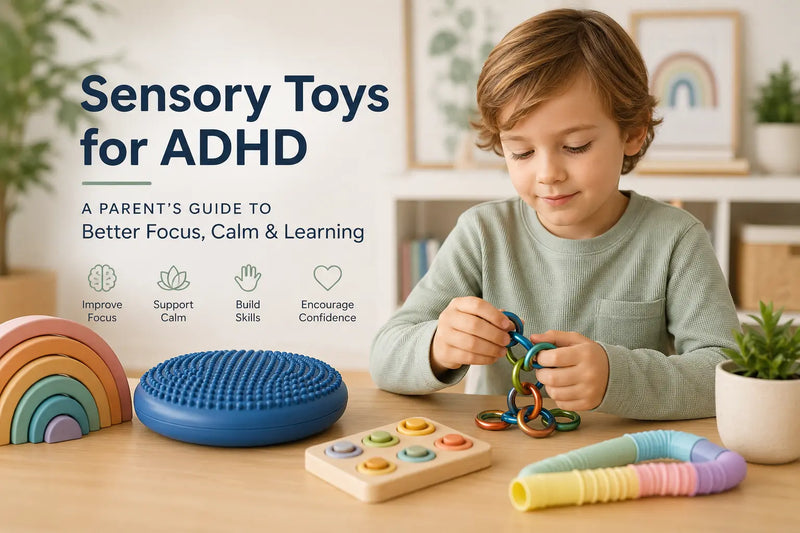
Sensory Toys for ADHD: A Parent's Guide to Better Focus, Calm and Learning
Wondering if sensory toys really help children with ADHD? This evidence-informed guide walks parents, educators and allied-health professionals through how sensory play supports attention, emotional regulation and learning, the toy categories that tend to work best, practical routines you can start this week, and how to choose high-quality, safe options for any age.
Quick answer: Many families and clinicians find that well-chosen sensory toys can help children with attention differences feel more regulated, focused and ready to learn. They work best when they are paired with movement, predictable routines, and supportive environments — not as a standalone fix. The Australian Parenting Today resource and the Raising Children Network note that sensory strategies are widely used by occupational therapists to support children with ADHD, alongside behaviour strategies, structure and, where appropriate, professional care.
What ADHD actually is (and what it isn't)
ADHD — Attention Deficit Hyperactivity Disorder — is a neurodevelopmental condition that affects how the brain regulates attention, impulse control, activity level and working memory. In Australia, the Australian ADHD Professionals Association and the NHS estimate that around 5–7% of children and adolescents meet the criteria for ADHD. It is one of the most studied neurodevelopmental differences in the world, and decades of research confirm it is a real, brain-based condition — not laziness, poor parenting, or too much screen time.
According to the US Centers for Disease Control and Prevention (CDC) and the Children and Adults with ADHD (CHADD), ADHD is understood as a difference in how the brain manages executive functions: planning, prioritising, starting tasks, finishing tasks, holding information in mind, and regulating arousal (the "up" or "down" state of the nervous system). Children with ADHD can absolutely pay attention — often to things that are highly stimulating or interesting (hyperfocus) — but sustaining attention to less stimulating tasks is genuinely harder for them.
Three things ADHD is not
- Not a discipline problem. Children with ADHD are not choosing to be inattentive. The brain's regulation systems work differently, and behaviour reflects that.
- Not caused by sugar, screens, or vaccines. Decades of research summarised by CHADD and the Australian Government's Department of Health have ruled out the most common myths.
- Not one-size-fits-all. There are three recognised presentations: inattentive, hyperactive-impulsive, and combined. Two children with the same diagnosis can have very different day-to-day experiences.
Why this matters for sensory play
Because ADHD affects how the brain regulates its arousal level, many children with ADHD are either under-stimulated (seeking input to wake up the brain) or over-stimulated (overwhelmed and needing to calm down). Sensory toys work by giving the brain a controllable, accessible source of input — tactile, proprioceptive, vestibular, or visual — that helps the child reach the "just right" state for learning. This is sometimes called sensory regulation, and it is one of the most widely used strategies recommended by occupational therapists.
If you would like a broader overview of how attention develops in early childhood, our complete guide to improving a child's concentration covers the developmental science in more detail.
How sensory toys help the ADHD brain
The phrase "sensory toy" gets used loosely. In occupational therapy, sensory tools are anything that meaningfully engages the senses — touch, movement, body position, sight, sound — to help the nervous system regulate. Raising Children Network, the Australian Government's national parenting resource, explains that sensory strategies are commonly recommended to support children who struggle to sit still, stay focused, or manage strong emotions.
The sensory channel cheat-sheet (at a glance)
This table summarises the nine sensory toy categories covered later in this guide, mapped to the sensory channel they primarily serve, the age range they suit, and the setting they tend to work best in. Use it as a quick reference when you are unsure where to start.
| Sensory toy category | Primary sensory channel | Best for ages | Best setting | Noise level |
|---|---|---|---|---|
| Fidget toys | Tactile | 6+ | School, meetings, travel | Silent |
| Stretch tubes and squishies | Tactile, proprioceptive | 5+ | Home, school | Quiet (some popping) |
| Busy boards and manipulators | Tactile, fine motor | 2–8 | Home quiet corner | Varies (mostly quiet) |
| Stacking and sorting toys | Visual, cognitive | 1–8 | Home, therapy | Silent |
| Magnetic builders | Visual-spatial, focus | 3+ | Home, classroom | Quiet clicking |
| Puzzles and logic toys | Cognitive, focus | 5+ | Home, after-school | Silent |
| Wobble cushions | Vestibular, proprioceptive | 5+ | School chair, desk | Silent |
| Balance and stepping stones | Vestibular, proprioceptive | 3+ | Indoor movement breaks | Silent |
| Music and sound toys | Auditory | 0–8 | Home, calming corner | Controllable |
The four sensory channels that matter most for ADHD
1. Tactile (touch)
Touch input goes straight to the brain's regulation centres. Many children with ADHD crave deep pressure or repetitive touch — squishy, stretchy, textured objects they can manipulate quietly. This is why fidget tools often work: they give the hands something to do so the brain can settle into a task.
2. Proprioceptive (heavy work)
Proprioception is the sense of body position and force — felt through muscles and joints. Heavy work activities (pushing, pulling, lifting, carrying, chewing) give the brain strong, organised input that tends to be calming. Carrying a stack of books, pushing a heavy wobble cushion, or doing wall pushes are all classic proprioceptive strategies.
3. Vestibular (movement and balance)
Vestibular input comes from movement of the head and body. Gentle, rhythmic movement is regulating (this is why so many children with ADHD calm down on a swing). Spinning, rocking, and balance challenges are stimulating and organising. This is why movement breaks are non-negotiable — not optional — for many ADHD children.
4. Visual and auditory
Some children seek visual stimulation (bright, moving, or spinning objects) and find clutter overwhelming. Others are highly sensitive to sound. Sensory tools that visually engage (think slow, mesmerising rainbow stacks) or quiet, contained sound (a small music table) can help either profile.
What the research says
Peer-reviewed research — including a 2021 systematic review published in the Journal of Attention Disorders — finds that sensory strategies and movement-based interventions are associated with measurable improvements in attention and on-task behaviour for children with ADHD. That said, the evidence is strongest when sensory strategies are combined with other supports: predictable routines, clear expectations, and, where appropriate, professional care from a paediatrician, psychologist, or occupational therapist.
For a closer look at the science of why kids fidget, see our article on Why Can't My Child Sit Still?
The 9 best types of sensory toys for ADHD
Not every toy labelled "sensory" is right for every child. Below are the nine categories that occupational therapists and parents consistently report as the most useful, organised by the sensory channel they primarily support. Use this as a checklist, not a shopping list — start with one or two items in the categories that match your child's profile.
1. Fidget toys (tactile, discrete)
Small, quiet, hand-held objects that give the fingers something to do. These are ideal for classrooms, car trips, and waiting rooms. The goal is not to stop the fidget — it is to channel it into an object that does not distract others. Look for pieces that are silent, durable, and not food-like (choking risk for younger children).
Good options from the WonderMinds Kids range include the WonderCalm Magnetic Rings and the Sensory Activity Fidget Board — both designed for quiet, repeated manipulation that channels restless hands into focused output.
2. Sensory stretch tubes and squishy toys (tactile, proprioceptive)
Pop tubes, mesh balls, and stretchy silicone shapes give the hands and arms a satisfying push-pull-poke. They are particularly useful for children who need proprioceptive input or who get agitated during long sitting tasks.
For a deeper tactile-and-sound experience, the WonderCalm Pop Tubes offer a satisfying mix of stretch, snap and pop that many children find regulating.
3. Busy boards and manipulative toys (tactile, fine motor)
Busy boards combine latches, knobs, switches, and textured panels. They build fine motor skills, give the hands complex work to do, and the variety of textures keeps the brain engaged. They are particularly useful for younger children who are still building the hand strength and finger control needed for school tasks.
For ADHD children, busy boards also serve a regulation function: small, controllable motor actions can be absorbing enough to keep the body busy while the brain attends to other input — a story, a school task, a conversation. Many families find a busy board does double duty, providing both sensory regulation and fine-motor practice in one object.
For a complete age-by-age breakdown of how fine motor skills and ADHD connect — including the underlying developmental sequence, what to build at home, classroom strategies, and when to seek OT support — see our fine motor and ADHD guide.
The Sensory Activity Fidget Board and the Steering Wheel Busy Board are two examples that combine multiple sensory experiences in a single piece.
4. Stacking and sorting toys (visual, cognitive, focus)
Stacking toys — especially the iconic rainbow stacker — engage visual perception, problem-solving, and hand control. They invite open-ended play, which means there is no single right answer. This is gold for ADHD children, who often disengage from closed, repetitive tasks faster than from creative ones.
The Premium Wooden Rainbow Stacker and the Wooden Rainbow Sorting Balls are examples of how a single open-ended toy can keep a child engaged for long, focused stretches.
5. Magnetic tile and block sets (visual-spatial, focus)
Magnetic building sets and construction toys are outstanding for sustained attention. They have a "just right" challenge curve — children can build simple structures quickly and progress to more complex ones. The satisfying click of magnets snapping together is its own sensory reward.
For sustained construction play, the Magnetic Tiles Building Set and the MagnetiCube Builder are versatile options that grow with the child.
6. Puzzles and logic toys (cognitive, focus)
Puzzles, especially 3D puzzles and wooden logic games, demand sustained attention and reward persistence. The American Academy of Pediatrics notes that puzzle play supports executive function development — exactly the area of challenge for many children with ADHD.
The Montessori Magnetic Maze Board and the MindCraft Wooden Logic Cube blend problem-solving with tactile satisfaction.
7. Wobble cushions and movement seats (vestibular, proprioceptive)
Inflatable or foam discs that sit on a chair. The unstable surface forces the body to make tiny postural adjustments, which is proprioceptive input. Many children with ADHD can sit still longer — and learn more — when their body is allowed to wiggle. Occupational therapists have used these in classroom settings for decades.
The Sensory Wobble Cushion is sized for children and discreet enough for school use.
8. Balance and stepping stones (vestibular, movement)
Indoor stepping stones and balance paths let children get movement breaks without leaving the room. They are excellent for school readiness, motor planning, and the kind of "heavy work" that calms the nervous system. Use them as a circuit, a brain break, or a quick reset between tasks.
WonderMinds Kids offers a Balance Stepping Stones Set and a Sensory Balance Path Stones Set designed for indoor use.
9. Music and sound toys (auditory, regulation)
Calming, predictable sounds — rain sticks, gentle xylophones, simple music tables — can be regulating for children who seek auditory input. The key is control: the child should be able to start, stop, and change the sound themselves. Active sound-making is regulating; passive loud noise is usually not.
The Montessori Music Table is an example of a self-contained instrument designed for early sound exploration.
For a broader overview of how play-based learning supports executive function, our guide to toys that build real skills covers skill-mapping in depth.
Sensory toys by age: what to choose, when
Development matters more than diagnosis. A toy that is perfect for a quiet seven-year-old will be dangerously small for a toddler. Below is an age-by-age framework to keep the right match in reach. These are general developmental guidelines drawn from the American Academy of Pediatrics and Raising Children Network — adjust to your child's individual profile.
0–3 years: regulation through the senses
For infants and toddlers, sensory play is the foundation of brain development. Choose:
- Texture-rich soft toys: Sensory Soft Balls, textured rattles, crinkle toys.
- Stacking toys: The KoalaSense Baby Stacking Tower introduces size discrimination and hand control.
- Activity gyms and play mats: Floor gyms like the Activity Sensory and Developmental Play Gym invite early visual tracking and reaching.
- Music toys: Simple instruments and the Music Table support auditory regulation.
Safety note: Avoid anything with small parts for under-threes. Watch for choking hazards — if it fits through a toilet roll, it is too small.
3–6 years: focus through play
Preschoolers are building the executive function skills they will rely on at school. Choose:
- Busy boards and fiddles: Multi-texture panels, simple latches, the Sensory Fidget Board.
- Sorting and matching toys: The Matching Eggs and Sorting Balls build focus through repetition.
- Construction toys: The Magnetic Tiles Building Set is ideal from age 3+ with adult support.
- Balance and movement: Stepping stones and balance boards as a movement break.
7–10 years: focus tools for school
School-age children with ADHD benefit from tools that fit inside a pencil case. Choose:
- Discrete fidget toys: WonderCalm Magnetic Rings, WonderCalm Pop Tubes, and a Sensory Activity Fidget Board for quiet, hands-on focus.
- Wobble cushions: A Wobble Cushion on the school chair is one of the most-requested sensory supports by occupational therapists.
- Construction and puzzles: 3D puzzles, magnetic builders, and the 3D Brain Teaser Puzzle for sustained focus.
- Open-ended sets: Wooden 3D Puzzles and balance sets for after-school reset.
11+ years: focus and emotional regulation
Older children and tweens want tools that don't feel "babyish". Choose:
- Adult-appearing fidget objects: Magnetic rings, mesh balls, metal puzzles.
- Strategy games: The Tetra Tower Stacking Game and Rope Logic Challenge reward planning and patience.
- Mindfulness toys: The Mindful Wooden Puzzle is designed for slow, calming problem-solving.
- Movement breaks: Stepping stones, balance paths, and active play sets.
For a deeper age-by-age breakdown, our best educational toys by age guide pairs developmental stages with skill-building play.
How to choose safe, ethical, durable sensory toys
Because sensory toys are touched, mouthed, dropped, and used hard, the quality bar is higher than for ordinary toys. Here is what to look for when you evaluate any product.
Pre-purchase checklist: 8 things to verify before you buy
Use this quick checklist every time you consider a new sensory toy. If a product fails more than two of these, it is not the right tool for your child or for daily use.
- ✓ Materials match the child's age. Solid wood for items that will be dropped; food-grade silicone for anything chewable; smooth, splinter-free finishes on wooden toys.
- ✓ Safety certifications are present. Look for AS/NZS ISO 8124 compliance in Australia, and the ACCC's mandatory toy safety standard mark.
- ✓ Age grading is appropriate. Many fidgets are not rated for under-threes because of small-part choking risk. Respect the rating even if your older child "still likes them".
- ✓ No magnets for under-threes. Swallowed magnets are a medical emergency. Magnetic building sets are for ages 3+ only, with adult supervision.
- ✓ Noise level matches the setting. Silent or near-silent for school. Quiet pop or click is OK at home. Loud electronic toys are rarely regulating.
- ✓ Open-ended play is possible. The toy can be used in 3+ different ways. Closed, one-button toys lose novelty fastest for ADHD children.
- ✓ Durable construction. Solid wood, metal, and quality plastic will outlast cheap plastic and fabric. A toy that survives a year of daily use pays for itself.
- ✓ Repairable or replaceable parts. Some brands sell replacement parts or re-finishing kits. A toy that breaks at month three is a wasted dollar.
Materials and safety
- Wood over plastic where possible. Sustainably sourced wood with non-toxic, water-based finishes is the gold standard for items that may end up in a child's mouth.
- Food-grade silicone for fidget items. BPA-free, phthalate-free, lead-free is the minimum. Look for FDA-grade or LFGB-certified silicone for chewable items.
- Age-graded, weight-tested construction. Magnetic toys must be securely sealed — swallowed magnets are a medical emergency. Wooden toys should be sanded smooth with no splinters.
- Reputable safety certifications. Australian distributors should comply with ACCC mandatory safety standards for toys. Look for AS/NZS ISO 8124 compliance on the packaging.
Design that supports regulation
- Open-ended beats one-trick. A toy that can be used in many ways holds attention longer than a toy that does one thing.
- Quiet beats loud. For classroom and public use, silent or near-silent fidgets are essential. Toys that click, squeak, or light up often distract other children.
- Heavy enough to feel, light enough to carry. A good fidget has weight in the hand without being tiring to hold for twenty minutes.
Materials comparison: wood vs silicone vs plastic vs fabric
The material a sensory toy is made of matters as much as the toy category. Each has trade-offs in safety, durability, sensory interest, environmental impact, and price. Use this comparison when evaluating a new purchase.
| Material | Best for | Safety | Durability | Sensory interest | Approx price band |
|---|---|---|---|---|---|
| Sustainably sourced wood | Stacking, puzzles, builders, busy boards | Excellent (food-safe finishes, no phthalates) | 10+ years | Grain, weight, sound | Mid–high |
| Food-grade silicone | Fidgets, chews, stretch toys | Excellent (BPA-free, phthalate-free) | 3–5 years | Texture, squish, stretch | Low–mid |
| High-quality plastic | Magnetic builders, technical fidgets | Good (check for BPA, phthalates) | 2–5 years | Bright colours, smooth | Low–mid |
| Natural fabric | Comfort objects, quiet books, weighted items | Excellent (washable) | 2–4 years | Soft, warm, sound-dampening | Mid |
| Metal (steel, aluminium) | Magnetic fidgets, fine-motor tools | Excellent (lead-free required) | Lifetime | Weight, temperature, click | Mid–high |
For most Australian families, the best long-term value comes from solid wood for items that will be used daily, food-grade silicone for tactile items, and natural fabric for comfort objects. WonderMinds Kids uses sustainably sourced wood and water-based finishes across the range, and publishes material specifications on every product page.
Longevity and ethics
- Durable construction. Toys that survive a year of daily use pay for themselves. Solid wood and metal outlast plastic and fabric.
- Ethical sourcing. Look for brands that are transparent about their supply chain. WonderMinds Kids, for example, works with small-batch craftspeople and FSC-certified wood.
- Repairable, not disposable. Toys that can be re-tightened, re-stained, or have parts replaced are a better long-term investment.
Daily routines that make sensory toys work
Sensory toys are most useful when they are part of a routine, not a rescue. Here are three ways parents and educators use them day-to-day.
Morning reset (5 minutes)
Before a busy school or work-from-home day, invite the child to choose a heavy-work activity: carrying a stack of books, doing 10 wall pushes, or completing a balance-stone circuit. Heavy work gives the brain a clear proprioceptive input signal that tends to anchor attention for the next 30–60 minutes.
Work-and-break rhythm (Pomodoro for kids)
For homework and reading, work in 15–20 minute blocks with a 5-minute movement break. During the break, set up a small sensory station: a wobble cushion, fidget toy, and stepping stones. The break is for movement, not screens.
This matches the CHADD recommendation that children with ADHD benefit from shorter stretches of focused work with built-in transitions.
End-of-day wind-down (10 minutes)
Late afternoon and early evening are often when dysregulation peaks. Offer slow, calming sensory input: a warm bath with soft toys, a quiet puzzle, a mindful stacking exercise, or a simple music instrument. The goal is to bring the nervous system down gently, not to introduce a new competitive game.
What to avoid in any routine
- Screens as a sensory substitute. They are over-stimulating and rarely regulating. See our guide to screen time and child development for the evidence.
- Sensory toys as a reward or punishment. They work best as tools, not prizes.
- Over-scheduling. Many children with ADHD are over-scheduled and under-rested. Routines only work if there is room in them.
A sensory diet: scheduling input across the day
Occupational therapists often talk about a sensory diet — a personalised plan of sensory activities scheduled across the day to help a child stay regulated. The term, coined by occupational therapist Patricia Wilbarger, refers to the same idea as a food diet: small, regular inputs that keep the nervous system balanced. A sensory diet is not restrictive. It is the opposite — it is a structured way to give a child the input they need before dysregulation sets in.
The four-part rhythm
Most sensory diets follow a four-part rhythm across the day. Adapt the timing to your family's routine, but the shape is consistent.
1. Morning activation (10–15 minutes)
The goal is to wake the body and brain up. Strong proprioceptive input is key: animal walks, wall pushes, carrying a stack of books, jumping on a trampoline, or completing a balance-stepping circuit. This sets the nervous system up for the demands of school or focused work.
2. Mid-morning focus block (20–30 minutes)
During focused work, provide a quiet fidget and a wobble cushion. The hands stay busy, the body stays subtly engaged, and the brain can settle into the task. Take a movement break before transitioning to the next subject.
3. Afternoon reset (10–15 minutes)
After lunch, the afternoon slump hits most children with ADHD especially hard. A heavy-work snack (chewy foods, crunchy vegetables), a proprioceptive activity (resistance band, push-ups against a wall), and 5 minutes of vestibular movement (swing, balance board, stepping stones) can re-regulate the system for the rest of the day.
4. Evening wind-down (20–30 minutes)
Slow, calming input is the goal. Avoid screens in the final hour. Offer a warm bath, gentle music, a quiet puzzle, a slow stacking exercise, or a mindful breathing exercise paired with a familiar sensory object. The nervous system begins to downshift, which supports sleep onset.
Building a sensory diet with your OT
If your child sees an occupational therapist, ask them to help design a personalised sensory diet. If you are flying solo, the American Occupational Therapy Association (AOTA) and Raising Children Network have parent-friendly templates. Keep notes for two weeks: what time did dysregulation peak? What seemed to help? Patterns emerge quickly.
Sleep, sensory needs and ADHD
Sleep and ADHD are deeply intertwined. Sleep difficulties affect up to 70% of children with ADHD, and poor sleep in turn worsens attention, mood, and impulse control. While sensory toys are not a treatment for sleep disorders, they can be a useful part of a healthy wind-down routine.
Why ADHD disrupts sleep
Children with ADHD often have a delayed circadian rhythm — they are not sleepy at the same time as their peers. The brain's "off switch" is harder to reach. Add screen time, caffeine, and irregular routines, and the problem compounds. The CDC and NHS both identify sleep hygiene as a key support for children with ADHD.
Sensory strategies for bedtime
- Heavy-work before bed. Gentle, slow wall pushes or animal walks in the early evening give the body one last dose of organising input.
- Weighted blankets provide deep-pressure proprioceptive input that is widely used in paediatric occupational therapy. Discuss with your OT if you are considering one — they are not one-size-fits-all.
- Calming auditory input. White noise, gentle music, or a bedside music toy can mask household sounds and down-regulate the nervous system.
- Tactile comfort objects. A soft toy, blanket, or familiar textured object can anchor the body when the brain is racing.
When to seek professional help
A 60-minute bedtime routine, step by step
Below is a sample wind-down routine for a child with ADHD, designed to bring the nervous system from alert to calm in about an hour. Adapt the timing to your family's schedule.
60 minutes before bed: heavy work
10 minutes of gentle proprioceptive input. Animal walks down the hallway, slow wall pushes, carrying a stack of books upstairs, or gentle stretching on the floor. This gives the brain one last dose of organising input and uses up residual physical energy.
45 minutes before bed: dim the lights
Lower the household lights. Switch to lamps or warm-tone bulbs. Bright overhead light tells the brain it is still daytime, which suppresses melatonin onset.
30 minutes before bed: screens off
All screens off — phone, tablet, TV, gaming console. Blue light suppresses melatonin for hours, and the content (especially stimulating games or social media) keeps the brain in an alert state. The Raising Children Network recommends no screens in the final hour before bed for all children, with extra caution for children with ADHD.
20 minutes before bed: warm bath or shower
Warm water provides deep-pressure proprioceptive input, raises then drops core body temperature (which signals sleep to the brain), and is a predictable transition ritual. A few drops of lavender oil or a quiet bath toy like the Sensory Spinner Set can extend the calming benefit.
10 minutes before bed: quiet wind-down
Choose one: a short story read aloud, a slow puzzle like the Mindful Wooden Puzzle, a music table at low volume, or slow stacking with a familiar set. Avoid screens, vigorous play, or anything stimulating.
In bed: comfort and predictability
Comfort object of choice (a familiar soft toy, blanket, or weighted item), low white noise or quiet music, dim light if needed, and a consistent goodnight routine. The brain learns to associate the sequence with sleep onset.
The role of consistency
One good night is not enough. The power of this routine is in the repetition — the brain learns the sequence and begins to downshift automatically after the first week or two. Weekend disruptions are fine; nightly discipline is what matters. The NHS identifies consistent bedtime routines as one of the most effective non-medical supports for ADHD sleep difficulties.
If sleep difficulties persist despite consistent routines, speak with your GP or paediatrician. There may be a co-occurring sleep disorder, anxiety, or sensory-processing difference that benefits from professional support.
Using sensory tools at school and in public
Handing a child a fidget toy in class is not always welcome. Here is how to make the case and set the child up for success.
Work with the teacher, not around them
Most teachers are open to sensory tools when the parent explains the purpose clearly. A short note that frames the fidget as a focus aid — not a toy — and offers a "if it becomes a distraction, I'll swap it" backup goes a long way. Many schools already have a sensory toolkit policy; if yours does not, the Raising Children Network has guidance on working with schools.
Choose school-appropriate fidgets
- Silent operation (no clicks, squeaks, or songs).
- Not edible-looking (avoid toys that resemble food for younger children).
- Compact enough to fit in a pencil case.
- Durable enough to survive a school bag.
Public outings: preparation beats reaction
For long car trips, flights, or waiting rooms, build a small sensory kit in advance: a fidget, a quiet hand tool, a small puzzle, and a snack that requires chewing. Chewing is a regulatory proprioceptive input for many children.
Working with teachers who are skeptical
Some teachers are unfamiliar with sensory tools and may see fidgets as a distraction. If that is your situation, frame the request in shared language: "this helps him stay on task." Offer a one-week trial with a clear plan. Cite the CHADD parent resources, which include a one-page teacher handout. If the school has a learning support team, ask them to advocate internally. As a last resort, sensory tools are usually permitted under reasonable adjustments for students with disabilities, though pursuing this route is rarely necessary when a calm conversation works.
A sample parent–teacher letter
Below is a short, non-confrontational letter template you can adapt. Keep it under 200 words — long letters are rarely read fully. Send it at the start of term or after a diagnosis update.
Dear [Teacher's name],
[Child's name] has ADHD and is supported at home with a small set of sensory tools that help him/her focus. The main one is a silent fidget that he/she keeps on the desk, plus a wobble cushion on the chair at home. These tools help him/her regulate movement so that attention can land on the work.
I'm writing to ask whether a similar arrangement would work in your classroom. The tool is silent and doesn't leave the desk. If it becomes a distraction to [child] or to other students, I'm happy to swap it for something else.
I've attached a one-page summary from CHADD (the national ADHD advocacy organisation) that explains the evidence for sensory supports. I'm also happy to chat by phone or email, and to meet at your convenience.
Thank you for everything you do for [child's name].
[Your name], [phone], [email]
If the teacher says no
Sometimes a teacher is unfamiliar with sensory tools or has had a bad experience with a distracting fidget in the past. If a calm letter does not work, the next steps are:
- Request a meeting with the school learning support team or special education coordinator.
- Ask the school's wellbeing or inclusion lead to advocate internally.
- If your child has a formal ADHD diagnosis, request the sensory tool as a reasonable adjustment under the Disability Standards for Education 2005.
- Document every request in writing. If you ever need to escalate, the paper trail matters.
Most Australian schools accommodate silent sensory tools without escalation. The cases that escalate tend to involve louder, more obviously distracting toys. Choose your tool well — that is the most effective prevention.
Common mistakes to avoid
After surveying hundreds of parents and educators, these are the mistakes that come up most often.
Mistake 1: Buying too many toys at once
Sensory toys work best when the child has a small, familiar toolkit. A dozen novel fidgets are less effective than two well-loved ones. Start with one or two items, see what gets used, and build slowly.
Mistake 2: Treating sensory toys as a cure
Sensory tools are supports. They cannot replace evidence-based care — parenting strategies, classroom accommodations, paediatric guidance, or allied-health input. CHADD and the CDC are clear: a multimodal approach works best.
Mistake 3: Letting a "sensory toy" become a screen
A tablet is not a sensory toy. A tablet is a screen. Some parents quietly swap a real sensory tool for a screen because the child is quiet. The research is consistent: this is a short-term win and a long-term loss.
Mistake 4: Choosing the loudest, brightest option
Most children with ADHD are over-stimulated, not under-stimulated. Bright flashing toys often dysregulate rather than help. Quiet, tactile, controllable toys almost always outperform flashy ones.
Mistake 5: Ignoring the child's lead
If your child gravitates to a toy that is not in any "sensory" list, follow their instinct. The most effective sensory input is the one the child actually chooses.
Mistake 6: Skipping professional input
If your child is struggling with hyperactivity, sleep, school, friendships, or mood, speak with a GP, paediatrician, or developmental psychologist. WonderMinds Kids is a toy brand — we are here for the play, and qualified professionals are here for the rest.
Understanding your child's sensory profile
Before choosing sensory toys, it helps to understand your child's individual sensory profile. The same toy can be calming for one child and completely over-stimulating for another. Two simple questions point you in the right direction.
Quick decision matrix: if you see this, try this first
Parents and educators often ask: "Where do I start?" The matrix below maps common presentations to a sensible first try. Use it as a starting point, then adjust based on your child's response over the next two weeks.
| If your child tends to… | Start with this sensory channel | First toy to try |
|---|---|---|
| Fidget constantly, can't sit still, craves input | Tactile + proprioceptive | Magnetic fidget rings + wobble cushion |
| Gets overwhelmed by noise, lights and crowds | Proprioceptive (calming) + tactile | Weighted lap pad + pop tubes |
| Loses focus within minutes of starting a task | Visual-spatial + tactile | Magnetic builders + balance stepping stones for breaks |
| Has big emotional outbursts, especially late afternoon | Heavy work + slow stacking | Rainbow stacker + stepping stones circuit |
| Can't fall asleep, racing thoughts at bedtime | Auditory + tactile comfort | Music table + familiar soft toy |
| Craves movement, can't focus unless moving | Vestibular + proprioceptive | Wobble cushion + balance path stones |
| Refuses messy play, dislikes certain textures | Tactile (gentle) + auditory | Sensory soft balls + quiet music toy |
Is your child a sensory seeker or a sensory avoider?
Most children with ADHD fall somewhere on a spectrum between seeking input (always on the move, craves loud noises, fidgets, crashes into furniture) and avoiding input (covers ears, dislikes messy play, avoids swings, refuses certain clothing textures). Many children are a mix of both.
- Sensory seekers usually respond well to high-intensity input: weighted blankets, heavy work, vibrating toys, deep-pressure squeezes, and bold tactile objects. They benefit from extra proprioceptive and vestibular input throughout the day.
- Sensory avoiders usually respond well to gentle, predictable input: quiet fidgets, soft textures, slow rocking, dim lighting, and one texture at a time. They benefit from advance warning before transitions.
What does "dysregulation" look like?
Dysregulation is the polite word for meltdowns, shutdowns, aggression, freeze responses, or sudden emotional outbursts. Most dysregulation is preceded by smaller early-warning signs: clenched fists, pacing, repetitive questions, whining, or sudden silliness. Catching these signs early — and offering a sensory tool at that moment — is far more effective than offering one in the middle of a meltdown.
Keeping a sensory diary
A simple notebook or note on your phone is enough. For two weeks, record:
- Time of day and what was happening
- What your child was doing (work, play, eating, transition)
- What you noticed in their body (tense, floppy, fidgety, still)
- What you tried, and how it worked
Patterns emerge quickly. Most parents discover a time-of-day pattern (often late afternoon) and a trigger pattern (transitions, hunger, unexpected changes). The sensory diet you build then targets those windows directly.
Printable 2-week sensory diary template
Use this template for two weeks to identify patterns. Photocopy or screenshot and tape to the fridge. Most parents see a clear pattern within 5–7 days.
| Day | Time | Context | Body signs | Tool tried | Result |
|---|---|---|---|---|---|
| Mon | |||||
| Tue | |||||
| Wed | |||||
| Thu | |||||
| Fri | |||||
| Sat | |||||
| Sun |
How to use the diary
- Time: Use approximate times — breakfast, mid-morning, lunch, after-school, dinner, bedtime.
- Context: What was the child doing? Homework, transition, screen time, social event, eating.
- Body signs: What did you notice? Tense shoulders, fidgeting, monotone voice, pacing, freeze, silliness.
- Tool tried: What sensory input did you offer, if any?
- Result: What happened in the next 10 minutes?
At the end of two weeks, look for two patterns: time-of-day (most children have a peak dysregulation window, often late afternoon) and trigger-pattern (transitions, hunger, unexpected change). Build your sensory plan around those two windows.
When to seek professional support
WonderMinds Kids is a toy brand. We are experts in play, not in diagnosing ADHD or designing clinical interventions. Sensory toys are a support, not a substitute. Many families benefit from working with one or more of the following professionals.
The Australian care pathway
- Start with your GP. They can refer your child for a paediatric or developmental assessment. In Australia, ADHD assessments can be done by paediatricians, child psychiatrists, or appropriately trained psychologists.
- Consider an occupational therapist. OTs trained in sensory integration can help design a sensory diet, identify your child's profile, and recommend specific tools and strategies.
- Consider a psychologist. Psychologists can support emotional regulation, anxiety, school refusal, and behavioural strategies. Many use play-based approaches for younger children.
- Speak with the school. Australian schools can implement reasonable adjustments under the Disability Standards for Education 2005. A sensory toolkit is a common and uncontroversial adjustment.
Red flags worth acting on quickly
- Persistent struggles at school that affect learning or friendships
- Emotional outbursts that are becoming more frequent or severe
- Sleep difficulties that last more than a few weeks
- Self-harm or talk of self-harm
- Sudden or dramatic changes in behaviour
If any of these resonate, please reach out to your GP. The Raising Children Network and the Australian Government Department of Health both have parent-friendly pathways to care.
) -->
Sensory play in different settings: home, school, travel, outdoors
The best sensory toy for a child depends on where they will use it. A wobble cushion works in a classroom but is awkward at the airport. A mesh fidget is silent on the bus but uninspiring for an hour at home. Below is a setting-by-setting breakdown.
At home: the dedicated sensory corner
Many families find it helpful to set up a small sensory corner — a rug, a low shelf, and a rotation of three to five toys the child can choose from independently. The corner should be:
- Quiet, but not isolated. Near the living area, not in a separate room.
- Visually calm. Neutral colours, low clutter. Bright walls over-stimulate many ADHD children.
- Bounded. A rug or mat signals "this is your space".
- Rotating. Five toys in, two toys out, every two weeks. Novelty matters more than volume.
Good corner-anchor toys include a wobble cushion, a busy book, a music table for younger children, and a magnetic tile set for older ones.
At school: small, silent, sanctioned
School sensory tools must pass three tests: silent, non-distracting to neighbours, and approved by the teacher. A magnetic fidget ring on the desk or a wobble cushion on the chair is the classic combination. See the dedicated section on using sensory tools at school for the full framework.
Travel and public outings: the "sensory kit"
Pack a small pouch with two tools per setting. For a flight or long drive: a silent fidget, a chewy snack, and a soft comfort object. For a restaurant or waiting room: a small magnetic puzzle, a travel spinner, or a wooden matching puzzle. Avoid toys with small parts that can be lost under seats — the frustration often outweighs the regulation.
Outdoors: heavy work and vestibular
Outdoor play is the most under-used sensory intervention in Australia. Climbing, swinging, balancing on logs, digging in sand, and riding a bike all provide heavy proprioceptive and vestibular input that many children with ADHD find deeply regulating. A 30-minute outdoor play session before homework or dinner can be more effective than any indoor sensory tool. See our Montessori Climbing Arch for at-home outdoor-style play.
Sensory toys for ADHD plus anxiety, autism, sleep or emotional regulation
Many children with ADHD experience overlapping differences — anxiety, autism, sensory-processing differences, sleep difficulties — and the sensory tools that help can be tailored accordingly. The principles are the same: regulation first, individualised second, professional support always considered.
Sensory toys for ADHD and anxiety
Anxiety-driven children are often in a state of physiological hyperarousal. The goal is calming, not alerting input. Prioritise:
- Deep-pressure proprioceptive tools: wobble cushions, weighted lap pads, wall pushes.
- Predictable, repeatable fidgets: magnetic rings, pop tubes.
- Slow, grounding activities: mindful wooden puzzles, slow stacking, deep breathing paired with a sensory object.
Avoid alerting tactile toys, bright flashing electronics, and anything that adds stimulation to an already-aroused nervous system.
Sensory toys for ADHD and autism
For children with both ADHD and autism, sensory differences are often more pronounced and more consistent. The CHADD and the Raising Children Network both note that sensory strategies used for autism — including proprioceptive tools, visual timers, and predictable sensory diets — overlap with those used for ADHD. WonderMinds Kids also has a companion article on sensory toys for autism and ADHD with autism-specific guidance.
Sensory toys for emotional regulation
Big emotions arrive fast for many ADHD children. Sensory tools can act as a circuit breaker — a tactile or proprioceptive input that interrupts the escalation cycle. The trick is to offer the tool at the first sign of dysregulation, not in the middle of a meltdown. A fidget board, a pop tube, or a rainbow stacker for slow, repetitive stacking can all serve this role.
Sensory toys for sleep
Sleep difficulties affect up to 70% of children with ADHD. Sensory strategies that support sleep onset include a calming wind-down routine, a familiar comfort object, a quiet music or sound toy, and gentle proprioceptive input (slow wall pushes, a warm bath, a quiet puzzle) in the hour before bed. See the dedicated sleep section above for the full framework.
Glossary of sensory terms for parents and educators
Sensory language is full of acronyms and clinical terms that can feel like a foreign language to parents. This glossary covers the most common terms you will see when reading about sensory strategies, ADHD, and occupational therapy.
ADHD
Attention Deficit Hyperactivity Disorder — a neurodevelopmental condition that affects attention, impulse control, and activity level. Has three recognised presentations: inattentive, hyperactive-impulsive, and combined.
Executive function
The set of brain skills that includes planning, starting tasks, finishing tasks, prioritising, and working memory. ADHD affects executive function development, which is why "trying harder" rarely helps.
Sensory channel
A category of sensory input — tactile (touch), proprioceptive (body position), vestibular (movement and balance), visual, auditory, olfactory (smell), or gustatory (taste). For ADHD support, the first four matter most.
Sensory diet
A planned schedule of sensory activities throughout the day, designed by an occupational therapist (or by parents using the framework) to keep a child's nervous system regulated. Coined by occupational therapist Patricia Wilbarger.
Sensory profile
An individualised map of how a child responds to sensory input — what they seek, what they avoid, and what is neutral. Every child has one. It is the foundation for choosing the right sensory tools.
Proprioception / proprioceptive input
Input from muscles and joints that tells the brain where the body is in space. Heavy work (pushing, pulling, carrying, lifting, chewing) is proprioceptive. It tends to be calming and organising for many ADHD children.
Vestibular input
Input from movement of the head and body, processed in the inner ear. Swinging, spinning, rocking, balancing — all vestibular. Rhythmic vestibular input is regulating; chaotic or excessive vestibular input can over-stimulate.
Tactile input
Input from touch — texture, pressure, vibration, temperature. Fidget toys are tactile input. Some children seek it (touch everything, dislike gloves) and some avoid it (refuse messy play, dislike tags on clothing).
Heavy work
Activities that involve pushing, pulling, carrying, or resistance. Wall pushes, animal walks, carrying groceries, jumping on a trampoline. Used in sensory diets to provide organising proprioceptive input.
Wobble cushion / wiggle seat
An inflatable or foam disc placed on a chair. The unstable surface forces the body to make tiny postural adjustments (proprioceptive input) which many ADHD children find regulating while seated.
Weighted blanket
A blanket filled with weighted material (often glass beads) that provides deep-pressure proprioceptive input. Used by many families to support sleep and emotional regulation. Discuss with your OT before buying — they are not one-size-fits-all.
Regulation / dysregulation
Regulation = a state of calm, alert, and ready to learn. Dysregulation = the opposite — overwhelmed, under-stimulated, or unable to transition. Sensory tools are used to move a child from dysregulation back to regulation.
Occupational therapist (OT)
An allied-health professional trained in sensory integration, fine motor skills, and daily-living skills. Many paediatric OTs specialise in ADHD and sensory support.
The evidence base: what research actually says about sensory tools and ADHD
If you have read three different parenting websites on this topic, you have probably seen everything from "sensory toys are life-changing" to "there's no evidence they work." The honest answer is in the middle, and it is worth understanding before you build a sensory toolkit around your child's needs.
What the research has established
The strongest evidence base is for the broader category of sensory-based interventions and movement-based interventions, used as part of a multimodal plan for ADHD. The Children and Adults with ADHD (CHADD) — the largest US advocacy and research organisation for ADHD — notes that sensory strategies are among the most common non-pharmacological supports recommended by occupational therapists working with ADHD children. The US Centers for Disease Control and Prevention and the NHS both describe multimodal care that includes behavioural, environmental, and educational supports alongside any medical care.
What the research has NOT established
No high-quality randomised controlled trial has shown that a specific brand or type of sensory toy produces a measurable, sustained improvement in core ADHD symptoms. The research field is constrained by three things:
- Heterogeneity. ADHD is a spectrum. A toy that helps one child may over-stimulate another, which dilutes study averages.
- Outcome measurement. Most studies use parent or teacher reports, which are subjective. Biomarker-based outcomes are rare.
- Blinding. You cannot easily blind a child or parent to a tactile intervention. Placebo effects (positive or negative) are hard to control.
What experienced clinicians report
Despite the research limits, occupational therapists working in paediatric settings consistently report that well-targeted sensory tools help children regulate, transition, and sustain attention — particularly when paired with movement breaks, predictable routines, and clear expectations. The American Occupational Therapy Association (AOTA) includes sensory integration principles in its practice guidelines for ADHD and related conditions.
How to read a single study (without becoming a scientist)
When you see a headline claiming sensory toys "work" or "don't work" for ADHD, check four things:
- Sample size. A study of 12 children is suggestive; a study of 1,200 is more reliable.
- Outcome. Did it measure what you care about — focus, regulation, learning — or a proxy like brain activity?
- Population. Were participants like your child — same age, same presentation, same comorbidities?
- Replication. Has the finding been reproduced by other teams? Single studies are starting points, not conclusions.
The practical implication: treat sensory tools as a well-evidenced support that is part of a multimodal plan, not as a standalone intervention. The Raising Children Network in Australia puts it plainly: sensory strategies are one set of tools in a larger parenting, educational, and clinical toolbox — not a replacement for any of them.
Sensory tools for ADHD in girls
ADHD in girls and women is consistently under-recognised and under-diagnosed, both in Australia and internationally. The CDC and the CHADD both report that girls are less likely than boys to be referred for ADHD assessment, particularly when their presentation is predominantly inattentive rather than hyperactive. The sensory needs of girls with ADHD are real and often missed.
Why girls with ADHD often go unnoticed
Girls are more likely to have the inattentive presentation of ADHD — daydreaming, losing track of tasks, struggling with working memory — rather than the hyperactive-impulsive presentation that draws adult attention. Girls are also more likely to "mask" — to suppress their visible ADHD symptoms in social and school settings. This masking is exhausting, often leads to anxiety, and means the child appears to be coping while internally working twice as hard as her peers.
How sensory needs show up differently in girls
- Quiet sensory seeking. Girls with ADHD often crave proprioceptive and tactile input in ways that look like daydreaming — hair twirling, doodling, leg bouncing under the desk.
- Social fatigue. Many girls with ADHD are highly social but find unstructured social time (lunch, recess) more draining than adults realise. A quiet fidget or a "reset corner" can help.
- Emotional intensity. Girls with ADHD often experience emotions more intensely and recover more slowly. Sensory tools that provide calming proprioceptive input (wobble cushion, weighted lap pad, slow stacking) are particularly useful.
- Masking-related burnout. By the time a girl is identified, she is often also dealing with anxiety, low self-esteem, or school refusal. The sensory plan should account for these comorbidities.
Sensory tools that tend to work well for girls
Tool selection is individual, but families and occupational therapists often report that quieter, less visually conspicuous tools work best for girls — both because the tools are less likely to draw social attention and because many girls with ADHD prefer subtle regulation over obvious intervention. Good options include magnetic fidget rings, wobble cushions, mindful wooden puzzles, and tactile stacking toys. The right tool is the one the girl herself chooses and uses — adult-selected tools are rarely as effective.
What girls with ADHD need that has nothing to do with toys
Most importantly, girls with ADHD need the same supports boys with ADHD receive: accurate identification, classroom accommodations, supportive healthcare, and parents and educators who understand the condition. The Raising Children Network has parent-specific resources for ADHD in girls, and the CHADD maintains an "ADHD in Women and Girls" resource hub. Sensory toys are useful supports, but they are not the whole answer.
Budget and value: building a starter kit at any price point
You do not need a drawer full of expensive toys. Most children with ADHD thrive on a small, well-chosen set of tools that they actually use. Below is a decision table for building a starter kit at three common budget levels. Prices are approximate AUD and refer to the WonderMinds Kids range as a reference — any equivalent quality toy will work.
Starter kit decision table
| Budget | What to buy | Why | Coverage |
|---|---|---|---|
| Under $40 | One magnetic fidget rings set | Silent, durable, school-safe, ages 5+ to adult | Tactile, focus |
| Under $80 | Magnetic fidget rings + a set of pop tubes | Adds proprioceptive / stretch input for stress regulation | Tactile, proprioceptive |
| Under $150 | Fidget rings + pop tubes + wobble cushion | The classic "home + school" combo: quiet fidget for the desk, wobble cushion for the chair | Tactile, proprioceptive, vestibular |
| Under $300 | The three above + a rainbow stacker or magnetic tile set | Adds an open-ended, focus-building toy for sustained quiet play | All four core channels |
| Under $500 | The four above + balance stepping stones or a balance path set | Full movement-break toolkit for indoor vestibular input | All channels + movement breaks |
The cost-per-day framework
A common mistake is judging sensory toys by purchase price. A better lens is cost per day of use. A wobble cushion used daily for two years at $50 costs about 7 cents per day. A set of magnetic fidget rings used daily for three years at $25 costs about 2 cents per day. Cheap plastic fidgets that break in two weeks are far more expensive per day of use than a $40 wooden toy that lasts a decade. The ACCC notes that durable, well-constructed toys also tend to be safer over their lifetime.
When to spend more, and when to spend less
- Spend more on tools the child uses every day — wobble cushions, magnetic builders, stacking toys.
- Spend less on tools you are trialling — pop tubes, mesh balls, small fidgets. Buy the cheapest acceptable version, then upgrade if it gets daily use.
- Never spend a lot on a single flashy electronic toy that promises a "cure". The evidence does not support them, and the child usually loses interest within weeks.
What to do when sensory tools aren't enough
Most families find that well-targeted sensory tools meaningfully help with focus, regulation, and learning. Some families find that even the best tools do not produce the changes they hoped for. Both experiences are real, and both deserve to be taken seriously.
Five reasons sensory tools may not be working
- Wrong sensory channel. The child needs proprioceptive input but the family is offering only tactile tools. Revisit the sensory profile section.
- Wrong timing. Tools offered mid-meltdown rarely help. The window for sensory input is the build-up phase, before dysregulation peaks.
- Underlying issue is more than sensory. Anxiety, sleep deprivation, learning differences, bullying, or unrecognised hearing/vision issues can all mimic or amplify ADHD-related sensory seeking. If sensory tools do not help after 4–6 weeks of consistent use, consider a paediatric review.
- Environment is the bigger lever. A child with no predictable routine, too much screen time, or insufficient sleep will not be regulated by toys alone. Sleep, movement, and structure are upstream of sensory tools.
- Clinical care is needed. For some children, sensory tools are one piece of a plan that should also include clinical support — paediatric, psychological, OT, or psychiatric. WonderMinds Kids is a toy brand, not a clinical service. We are here for the play, and qualified professionals are here for the rest.
Graduating to the next step
If sensory tools have given your child some relief but you sense something more is needed, the next conversation is usually with your GP or paediatrician. The Australian care pathway (covered in When to seek professional support) is designed so that sensory tools, OT input, school accommodations, and clinical care all reinforce each other rather than compete. There is no "either/or".
What to do with tools that are no longer useful
Children outgrow sensory preferences. A toddler's busy board becomes a 10-year-old's puzzle. The wobble cushion that worked at 6 may be too small at 12. The right move is to:
- Rotate tools in and out of use every 4–8 weeks.
- Pass on toys that no longer fit to younger siblings, family friends, or community playgroups.
- Avoid discarding tools abruptly — many children have an emotional attachment to "their" fidget or comfort toy.
The goal is not to accumulate toys. It is to maintain a small, well-loved toolkit that grows with your child.
Frequently asked questions
This FAQ is built from the questions parents, educators and allied-health professionals most often ask about sensory toys for ADHD. Every answer is consistent with current evidence from the CDC, NHS, CHADD and the Raising Children Network. For more detail on any topic, jump back to the relevant section of this guide.
Sources and further reading
This article draws on the following authoritative sources. All are reviewed and updated regularly.
- US Centers for Disease Control and Prevention (CDC) – ADHD
- Children and Adults with ADHD (CHADD)
- NHS – ADHD overview
- Raising Children Network (Australia)
- American Academy of Pediatrics – HealthyChildren.org
- Australian Government Department of Health
- Australian Competition and Consumer Commission (ACCC) – Product Safety
- American Occupational Therapy Association (AOTA)
Peer-reviewed references include systematic reviews in the Journal of Attention Disorders and the Journal of Occupational Therapy, Schools, & Early Intervention on sensory integration and ADHD.
Find the right sensory tools for your child
WonderMinds Kids designs open-ended, durable sensory and developmental toys for Australian families. Many of the tools mentioned in this guide — fidgets, wobble cushions, balance sets, magnetic builders, and wooden puzzles — are part of our core range.
Browse the Sensory collection, or explore our Montessori Toys collection for open-ended play that supports focus and learning. For quick, focused tools, the Fidget Toys collection is a strong starting point. Have questions? Email our team — we are happy to help families find the right fit.