Watching your child flit from one toy to the next, struggle to finish a sentence, or seem like they're "not listening" even when they're looking right at you — it can leave you wondering what's happening in their brain, and whether you're doing enough to help.
If you've found yourself searching "how to help a child with ADHD focus without screens," you're already thinking in exactly the right direction. And you don't need an app or a device to do it.
This guide walks through practical, evidence-based strategies for supporting attention naturally — through play, movement, sensory engagement, and the right environment. Suitable for children from toddler age through early primary school.
Understanding ADHD and Focus in Young Children
If you've ever watched your child start five things in ten minutes, abandon each one just as quickly, and wondered if something was "wrong" — you are not alone. Many parents of spirited, energetic children find themselves asking the same question, particularly when their child starts kindy or school and the expectations for sustained attention increase.
Attention Deficit Hyperactivity Disorder (ADHD) is one of the most common neurodevelopmental conditions in children. In Australia, estimates suggest around 5–7% of school-aged children are diagnosed with ADHD, though many more show attentional differences that don't always fit a clinical label. What parents consistently report isn't just the hyperactivity — it's the frustration of a child who wants to focus but finds it genuinely difficult.
The good news? There is a great deal that parents can do at home — without reaching for a tablet, an app, or a screen of any kind.
Signs of ADHD or Attention Difficulties in Young Children
It's worth being clear: not every active, distractible toddler has ADHD. Attention spans naturally shorten in early childhood, and what's developmentally appropriate at age 3 looks very different from what's expected at age 7. However, some signs may indicate a child who finds sustained attention particularly challenging:
- Difficulty returning to a task after being interrupted
- Frequently losing items — toys, shoes, school materials
- Extreme restlessness — rarely sits still even for stories
- Appearing not to listen when spoken to directly
- Switching activities so quickly there's no apparent engagement with any of them
- Finding it hard to wait their turn in games or group activities
If your child shows several of these signs consistently, and they're affecting their learning or relationships, it's worth speaking with your GP or a paediatrician. A formal assessment can be genuinely helpful — not as a label, but as a pathway to the right support.
The Natural Focus Approach: Why It Works
When a child with ADHD is genuinely absorbed in something — completely in flow — something remarkable happens. The fidgeting stops. The eyes lock on. The world narrows to the task at hand. This state is sometimes called "hyperfocus," and while it can sometimes look like zoning out, it's actually a window into what focused attention can look like for these children when the activity is the right fit.
The goal of natural focus strategies isn't to force a child's attention. It's to create the conditions where sustained attention becomes possible — even enjoyable — without relying on the artificial engagement of a screen.
Strategy 1: Sensory Play for ADHD Focus
Sensory play is one of the most powerful tools for supporting attention in children with ADHD. Why? Because sensory activities directly engage the neurological systems that underlie attention and self-regulation — the tactile, proprioceptive, and vestibular senses.
Montessori classrooms have understood this for over a century. The Montessori approach uses carefully designed, hands-on materials that require sustained concentration — not because children are forced to focus, but because the materials themselves invite it.
Open-Ended Play with Purpose
Open-ended toys — things that can be used in many different ways — are particularly well suited to children who find rigid tasks frustrating. A child who struggles to follow a single correct approach can still engage deeply with a set of stacking blocks, a threading activity, or a set of nesting toys. There is no "wrong" way, but the complexity of play grows naturally as attention develops.
Look for toys that require bilateral coordination (using both hands together), sustained visual attention, and fine motor control — these all activate the attention networks of the brain.
What to Look For
Montessori materials share certain characteristics that make them particularly helpful for children with attentional differences:
- Wooden and natural — less visual noise than brightly coloured plastic, easier on the developing sensory system
- Simple and orderly — a limited number of pieces that each have a clear purpose
- Self-correcting — the material gives feedback when something doesn't match, without needing adult intervention
- Scalable complexity — the same toy can be used in simpler ways when attention is low, and in more complex ways as focus builds
For a deeper look at the 9 sensory toy categories that work best for ADHD — including tactile, proprioceptive, vestibular and oral-motor tools, age-by-age picks, and a comparison table — see our complete guide to sensory toys for ADHD.
Strategy 2: Movement Breaks for ADHD Focus
Here's a truth that many parents intuitively know but schools sometimes forget: children with ADHD often need to move in order to focus, not instead of focusing. Movement isn't a distraction from attention — for many children, it is the mechanism of attention. For a broader look at developmental and sensory factors behind movement, read our guide to why some children find sitting still difficult.
Building Movement Into the Day
Rather than asking a child to "sit still and focus," try scheduling movement breaks before tasks that require sustained attention. A short burst of physical activity — jumping, swinging, climbing, or even a brisk walk — increases dopamine and norepinephrine in the brain, the same neurotransmitters that ADHD medications target. This makes the brain more receptive to focusing immediately after.
This isn't about tiring a child out. It's about using movement strategically to prime the brain for what comes next.
Outdoor Time and Nature
Research consistently shows that time in natural environments — even urban green spaces — reduces attentional fatigue. A child who has been indoors all morning will find it easier to concentrate after 20 minutes outside than after another 20 minutes of indoor structure.
Where possible, incorporate outdoor, open-ended play into your daily routine. Not a sports game or a structured activity — just free play in nature, where the child decides what happens. This kind of play is demanding in the best way, requiring sustained attention and creative problem-solving without the child even realising it.
Strategy 3: Routines and Visual Supports
Children with ADHD often struggle with time — not just in the sense of "knowing what time it is," but in feeling the passage of time and knowing where they are within an activity. This is one of the reasons transitions can be so challenging: a child deeply engaged in one thing is genuinely caught off guard when it's time to stop.
Visual Schedules and Timers
A simple visual schedule — a sequence of images showing what comes next in the day — helps children with ADHD understand what's expected without relying on verbal instructions that vanish the moment they're given. Paired with a visual timer (a sand timer works beautifully for young children), it gives the child something concrete to hold onto as time moves.
Picture cards are easy to make at home, or you can use objects themselves as visual cues — placing the next activity's materials in a basket as a signal that a transition is coming.
A Predictable Environment
Minimising clutter and visual distractions in the environment helps children with ADHD direct their attention more easily. This doesn't mean a bare room — it means having a clear, consistent home for everything, and keeping the number of toys available at any one time manageable. Rotating toys weekly is a well-established strategy: the same toys feel fresh and engaging when they've been temporarily absent.
Strategy 4: Play-Based Learning That Builds Attention
Play-based learning isn't just "how young children learn" — it's actually the format that generates the deepest, most sustained attention in young children. When play is self-directed and intrinsically rewarding, the brain's attention systems engage at full capacity.
Montessori and constructivist approaches to play-based learning are particularly well suited here because they give children agency while providing enough structure to support attention. The child chooses the activity — but the materials are designed to be inherently engaging and to grow in complexity as the child's skill develops.
Toys That Build Focus Over Time
Some toys are better than others at scaffolding attention. For a full breakdown of the everyday habits, environment changes, and play patterns that build sustained focus — not just attention on a single toy — see our practical guide to improving a child's concentration.
Some categories of toys are particularly effective at this:
- Stacking and nesting toys — require sustained visual-motor coordination and sequential thinking
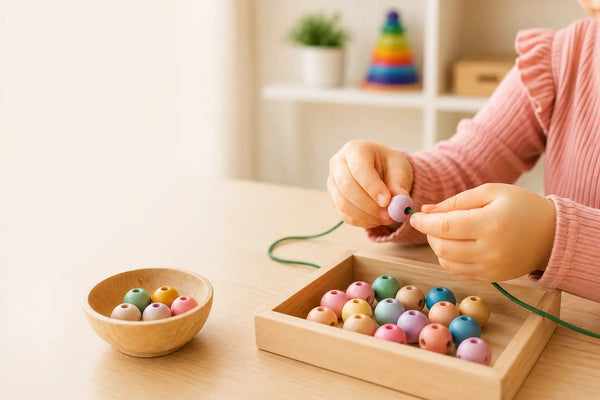
- Threading and lacing activities — develop fine motor control and sustained attention simultaneously
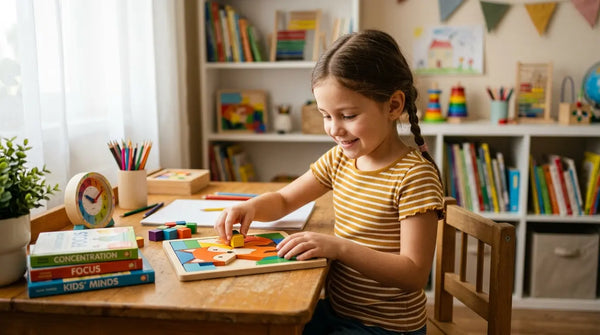
- Puzzles — spatial reasoning, problem-solving, and the satisfaction of completion
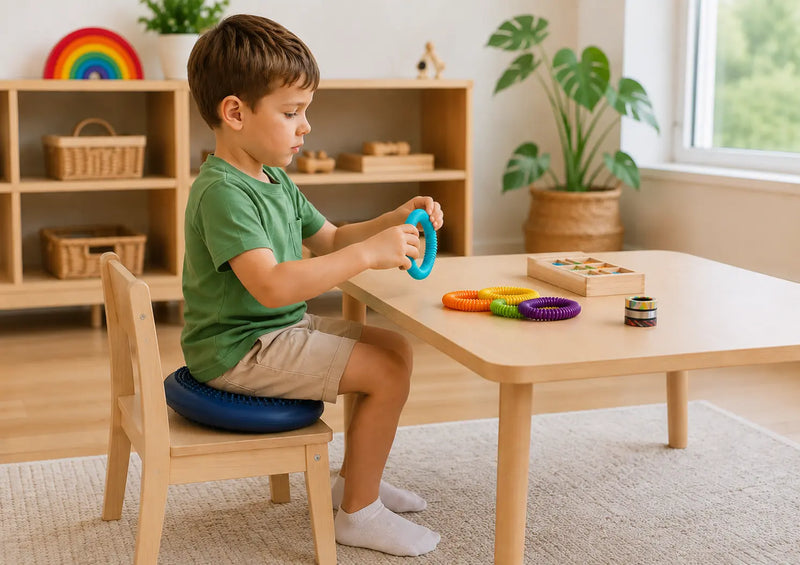
- sensory boards and fidget tools — provide the tactile input some children need to stay regulated enough to attend
When choosing toys for a child who finds attention difficult, look for toys that have a clear "end point" — something that tells the child "you're finished" when it's done. This gives a sense of completion that children with ADHD often crave but struggle to generate on their own.
Strategy 5: Emotional Regulation Skills
ADHD is not just about attention — it's closely linked with emotional regulation. Children with ADHD often experience emotions more intensely, transition between emotional states more quickly, and find it harder to self-soothe when upset. All of this makes sustained attention harder, because emotional dysregulation competes for the same cognitive resources.
Teaching Children to Name and Manage Big Feelings
Simple emotional literacy — naming emotions as they arise — is one of the most underrated attention tools. A child who can say "I'm getting frustrated" has taken the first step to managing that frustration, rather than being overwhelmed by it. Books, role-play, and simple check-ins throughout the day all help build this skill.
For younger children, picture cards showing different emotions are a gentle entry point. For older toddlers and preschoolers, a feelings chart on the wall gives language to feelings that are still too big to articulate.
The Role of Co-Regulation
Before children can regulate their own emotions, they co-regulate — they borrow the calm of the adults around them. This means that your own regulated, calm presence is one of the most powerful tools you have. When you stay grounded during a meltdown, you're not just "managing the situation" — you're actively teaching your child's nervous system what calm feels like.
Age-Specific Activities: From Toddlers to Early Primary
Attention looks different at every developmental stage. What works for a toddler won't translate directly to a 6-year-old, and the approach needs to evolve as your child grows.
Ages 0–2: Building the Foundation
At this age, attention spans of even a few minutes are significant. Focus on sensory-rich, simple activities with a clear start and finish:
- Fill-and-tip games with containers of different sizes
- stacking rings and blocks that topple with satisfaction
- Pop-up toys that require cause and effect
- Singing songs with hand motions — music and movement together
Short, repeated exposure is more effective than long sessions. Playing the same activity twice in one day is not repetition — it's mastery building.
Ages 3–5: Growing Engagement
At this age, children can engage with increasingly complex open-ended play. Introduce activities with a slightly longer commitment:
- Nesting and stacking toys with more pieces
- Threading beads onto cords or pipe cleaners
- Simple puzzles (6–12 pieces)
- Sensory bins with hidden objects to find
- Small-world play — setting up and completing mini scenes
Ages 6–8: Building Sustained Attention
At school age, children are being asked to sustain attention for longer periods. Continue to use hands-on, movement-rich activities but introduce more challenge and complexity:
- Complex puzzles (24+ pieces)
- Construction sets requiring sequential building
- Card games with simple rules that require attention and memory
- Nature journaling — drawing what they observe outdoors
- Story creation — sequencing events verbally or visually
Supporting Your Child Day to Day
None of these strategies work in isolation. What makes the biggest difference is the overall environment you create at home — a space that is calm enough to support attention, rich enough to be engaging, and structured enough to provide the predictability that children with ADHD benefit from.
Small changes add up. You don't need to overhaul your home or your routine overnight. Start with one or two strategies that feel manageable, and build from there.
When to Seek Professional Support
Natural focus strategies are genuinely helpful, but they don't replace professional support when it's needed. If your child is consistently struggling with attention to the point where it's affecting their learning, relationships, or wellbeing — or where it's significantly affecting family life — a conversation with your GP or a child psychologist is a reasonable and helpful step.
Occupational therapists, in particular, have specialist expertise in sensory processing and attention, and can provide very targeted strategies for your child's specific profile. Behavioural support and, in some cases, medication assessment are also valid pathways that many families find genuinely helpful.
Seeking support is not a failure. It's responsive parenting at its best.
Final Thoughts
Watching your child struggle with attention is one of the most frustrating experiences of parenting. You want so badly to help them, and it can feel like nothing you do is quite enough. But the research is clear: the environment, the toys, the routines, and the relationships you create around your child genuinely do make a difference.
You are already doing more than you realise. The fact that you're reading this — looking for practical, evidence-based ways to support your child — is a form of care that matters enormously.
Building focus naturally isn't about forcing a child's attention or removing all difficulty from their path. It's about creating the conditions where their natural curiosity and capacity for engagement can flourish. And that starts with play.
WonderMinds Kids curates open-ended, Montessori-inspired toys designed to support sustained attention, fine motor development, and creative play. Every toy is chosen to grow with your child — not outgrown in weeks.