It's 7:30 on a Tuesday evening. Your four-year-old is wrestling a button. Your six-year-old has a fist-shaped grip on a pencil that the teacher has gently mentioned twice. Your toddler is trying to spear a pea with a fork and is losing patience faster than the pea is losing ground. The school holidays are full of scissor-craft suggestions on Pinterest, but every time you sit down to "do fine motor", the activity turns into a power struggle.
Many parents first hear the phrase "fine motor skills" when a teacher, grandparent, or paediatrician mentions it — usually as a concern. Often there's no real problem; the adult just isn't sure what fine motor actually means, what the typical range looks like at a given age, or how to support it without turning every mealtime into a pencil-grip lecture. This guide exists so you can stop wondering and start noticing — because fine motor skills matter: they build the independence children feel in dressing themselves and eating without help, the confidence that comes from "I did it myself", the everyday readiness for learning, and, later on, the writing fluency that supports every other school subject.
This guide is the long answer to a common question — fine motor skills activities: what they are, how they differ from gross motor, how they develop in a typical child from birth through to early school age, what activities genuinely build them at home and in the classroom, how to track progress calmly, and when it's worth raising concerns with a health professional. It includes age-by-age activity plans, original comparison tables, printable templates and an FAQ built from the questions parents actually search for.
Read it cover-to-cover once, then dip back in whenever a new age or stage arrives. If you're already in the middle of a specific stage — buttons, scissors, pencil grip — the complete guide to improving a child's concentration covers many of the same focus and regulation foundations.
What you'll learn from this guide
Fine motor skills are the small, precise movements we make with our hands, fingers, thumbs and wrists — gripping, pinching, twisting, cutting, threading, writing. They build gradually on top of gross motor stability (the larger postural movements that hold us upright and balanced), and they underpin almost every practical task a child learns: dressing, eating with utensils, drawing, using scissors, buttoning, opening packets, handwriting.
This guide covers:
- What fine motor skills are, and how they differ from gross motor.
- The five-stage building block sequence that underpins every fine-motor skill a child learns.
- Typical milestones from birth through age 8, with a quick-reference table.
- Age-banded activities for babies, toddlers, preschoolers and early school-age children — including the Wonder Minds Kids toys that suit each stage.
- Handwriting, scissor skills and school readiness, with progression tables.
- Household and classroom activities that build fine motor without it feeling like extra work.
- Neurodiversity-affirming adaptations for children who process touch, movement or attention differently.
- How to track progress calmly at home.
- When to seek support, and who to see first.
- A sample weekly plan you can adapt to your family.
- 30+ frequently asked questions.
Age ranges throughout this guide are approximate guides, not milestones. Children develop at different rates, and a wide range of "typical" is healthy. If something here doesn't match your child's pace, that's often perfectly normal — the section on when to seek support explains what to look for.
What are fine motor skills?
What to try tonight: notice what your child's hands are doing in the next hour — reaching for a cup, picking up a crumb, turning a page, scribbling on a notepad. Every one of those small movements is a fine motor skill in action.
Fine motor skills are the precise movements we make with the small muscles of the hands, fingers, thumbs and wrists. The term covers everything from a baby raking a handful of cereal into a fist, to a five-year-old cutting a circle from paper, to an eight-year-old writing a complete sentence with a dynamic tripod pencil grip. Open-ended, hands-on play provides many natural opportunities to practise these movements — children pull, twist, balance, fit, sort, thread and stack their way into mastery.
Three broad families of fine motor movement show up across every age:
- Grasp patterns — palmar grasp, raking grasp, pincer grasp, tripod grip. Each one prepares the hand for the next.
- In-hand manipulation — adjusting an object inside the hand without looking. Picking up a coin from the palm and turning it to slot it into a piggy bank is a classic example.
- Tool use — using implements to extend what the hand can do: spoons, crayons, scissors, pencils, toothbrushes, keys, buttons.
Fine motor is sometimes treated as a "school-readiness" issue, but the foundations are laid in infancy. The same neural pathways that let a six-month-old reach, grasp and transfer objects between hands eventually run a handwriting stroke.
Two clarifications that prevent a lot of confusion:
- Fine motor is not just handwriting. Handwriting is one of the last fine motor skills to mature, and it depends on many earlier skills being in place. Working on a pencil grip before the supporting skills are ready usually doesn't help.
- Fine motor is not the same as intelligence. A child with strong language and reasoning can still have a slower-than-typical fine motor trajectory, and vice versa. The two systems develop on overlapping but distinct timelines. A slower fine motor trajectory on its own does not predict future academic ability — many children with late-emerging pencil control go on to do very well at school, especially once their hands, attention and confidence have caught up.
Throughout this guide the term typical is used deliberately. There is a wide range of what is healthy, and a child developing a little earlier or later than the average usually falls well within that range. The milestones later in this guide describe that range, not a single expected age for each skill.
Fine motor vs gross motor: what's the difference?
What to try tonight: ask your child to do three things in a row — stand on one leg (gross), thread a bead (fine), jump and land (gross), pinch a small grape (fine). Notice how each task uses a different part of the body and a different kind of attention.
Gross motor skills use the large muscle groups — the trunk, shoulders, hips and legs — to move, balance and stabilise the body. Fine motor skills use the small muscles of the hands and fingers, supported by stable wrists, forearms and a steady trunk. The two systems are deeply connected: a child can't write neatly without a stable shoulder, and they can't run smoothly without the core stability that lets the legs coordinate. Fine and gross motor develop together rather than in separate lanes, and many everyday activities — climbing, dancing, pouring water, threading a bead while sitting on a wobble cushion — support both at the same time.
| Gross motor | Fine motor | |
|---|---|---|
| Muscle groups | Large: trunk, shoulders, hips, legs | Small: hands, fingers, thumbs, wrists |
| Examples | Sitting, crawling, walking, jumping, balancing, climbing | Grasping, pinching, threading, cutting, drawing, buttoning |
| Body region | Whole body, mostly away from the midline | Hands and wrists, often across the midline |
| Attention style | Often whole-body and outward-looking | Often close-focus, inward-looking |
| Everyday example | Climbing onto a chair, riding a trike | Threading pasta onto a dry spaghetti, picking up a raisin |
| Classroom support | Movement breaks, wobble seats, balance tools | Pencil grips, cutting tools, manipulative toys, tabletop tasks |
| Underpinning skill | Postural control, coordination, balance | Hand strength, finger dexterity, bilateral coordination |
Two practical takeaways from this comparison:
- Fine motor depends on gross motor. A child whose shoulders and core aren't yet stable will struggle to control their wrists and fingers. Floor play, climbing and balancing aren't a detour from fine-motor work — they're the foundation.
- Fine motor underpins everyday independence. Buttons, zips, lunchboxes, cutlery, toothbrushes, school bags — every one of these is a fine-motor task dressed up as a self-care task. Building fine motor is also building independence.
The next section walks through the five-stage building block sequence that connects the two systems — from a baby's first reach to a school-age child's dynamic tripod grip.
The building blocks of fine motor development
What to try tonight: watch your child pick up a single grape and bring it to their mouth. Notice how many micro-skills that one movement uses — and how each of those skills had to be in place first.
Fine motor doesn't appear out of nowhere at age four when it's suddenly time to hold a pencil. It builds on a sequence of earlier skills, each one enabling the next. The five-stage sequence below reflects how paediatric occupational therapists describe hand development in children, and aligns with the developmental frameworks used by the Royal Children's Hospital Melbourne and CanChild.
Stage 1 — Shoulder and core stability. Floor play — tummy time, rolling, crawling, climbing — lays this foundation. Raising Children Network describes tummy time as one of the most important early practices for building the postural strength a child will draw on for every later hand skill.
Stage 2 — Arm and wrist stability. A toddler propping their elbow on the table while scribbling, or bracing their wrist to push a bead onto a string, is showing this stage in action.
Stage 3 — Hand strength and grip patterns. The hand develops its own repertoire of grips: palmar grasp, raking grasp, pincer grasp (thumb and index finger together), and eventually tripod grip. There's no rush to reach the tripod grip, and forcing it rarely helps.
Stage 4 — In-hand manipulation. The "hidden" fine-motor skill: adjusting an object inside the hand without looking. Picking up two coins, picking them up one at a time, slotting the second into a slot without putting it down first — that's three distinct steps.
Real-life example: when a three-year-old unpeels a sticker, transfers it to the back of their hand to "save it", then peels it off and presses it onto paper — that's stage 3, stage 4 and stage 5 running at once.
Stage 5 — Tool use. Tools extend what the hand can do: a spoon, a crayon, scissors, a toothbrush, a fork, a pencil. Tool use depends on stages 1–4 being in place. This is one reason handwriting is best supported by a wide range of pre-writing activities, not by more pencil practice.
Two practical points: children move between stages fluidly — the sequence is most useful when something isn't working, as a way to ask "which earlier skill might need more support?". And the earlier stages often need the most time: tummy time, crawling, climbing and heavy work aren't preschool distractions — they're the foundation for handwriting three years later.
🩺 Occupational Therapist Insight
The most common misconception about fine motor development is that it's a "pencil grip" issue. Most pencil-grip difficulties in children under six are really shoulder-stability, wrist-positioning or hand-strength issues in disguise. Working on pencil grip directly often doesn't address the underlying issue. Working on the earlier stages tends to lead to better long-term outcomes.
🌱 This week's focus
- Watch one fine-motor moment — meal, getting dressed, drawing — and notice which stage your child is using most.
- Add five minutes of floor play if you have a baby or toddler: crawling, climbing, carrying a heavier toy.
- Skip the pencil-grip conversation if your child is under six. Build the foundation instead.
Why fine motor skills matter for school readiness
What to try this week: look at the morning routine through a fine-motor lens for a single day. Count how many steps involve hands — opening a lunchbox, peeling a banana, zipping a bag, brushing teeth, putting on shoes. That's the same number of fine-motor tasks a typical school morning requires, often in a 20-minute window.
When teachers and prep teachers talk about school readiness, they include school readiness fine motor skills as one of the most concrete parts of the picture. Teachers consistently identify the same handful of fine-motor-linked skills as making the biggest difference to a child's first year of school:
- Self-care at school — managing lunchboxes, drink bottles, jumpers, shoes, hats and toilet trips independently. Every one is a fine-motor task.
- Tool use in the classroom — pencils, crayons, scissors, glue sticks, paintbrushes, rulers. A child whose hands tire quickly during drawing will often avoid the drawing corner.
- Sustained tabletop work — sitting at a task with stable posture and using hands for 10–20 minutes without fatigue.
- Handwriting fluency — letters that take huge effort leave less cognitive bandwidth for spelling and sentence construction.
Handwriting gets the most attention, but confidence and independence matter just as much. A child who can dress themselves, open their lunchbox, manage their belongings and join in classroom craft without help arrives at school ready to learn — and that everyday independence is just as valuable as legible handwriting.
The single biggest predictor of early handwriting fluency isn't early pencil practice — it's the variety and volume of pre-writing hand experiences a child has had. Cutting, threading, beading, playdough, water pouring, sand play, construction with small pieces, dressing practice: each builds a different aspect of the same underlying skill. The broader guide to hands-on toys that build real skills covers the categories behind this list. Posture, movement and regulation are closely connected to fine motor work — if your child finds it hard to sit still during tabletop tasks, our sensory toys guide for calm and focus covers the regulation side, and our complete guide to improving a child's concentration covers focus strategies.
🌱 This week's focus
- Audit one morning routine through a fine-motor lens: how many hand tasks does it actually involve?
- Pick one self-care skill your child is close to managing independently (zip, button, lunchbox clip) and let them practise it daily for a week.
- Swap one screen session for a 15-minute tabletop or floor activity — threading, playdough, or kitchen pouring.
Fine motor milestones by age: what to expect
Fine motor milestones by age describe the typical range of small-muscle skills a child develops between birth and age eight — reaching, grasping, releasing, bilateral coordination, tool use, drawing, and self-care tasks like buttoning and using cutlery. The reference points below draw on the CDC's developmental milestones framework and Raising Children Network's age-by-age guides.
What to try tonight: find the row that matches your child's current age, and pick one skill from the table to gently observe this week — without teaching, just noticing.
The table below maps typical fine motor milestones by age from birth to eight. Age bands are deliberately wide because the range of "typical" is wide, and children develop at different rates. The reference points are drawn from the CDC's developmental milestones framework and Raising Children Network's age-by-age guides — both describe the centre of the range, not the only healthy pattern. Use the table the way a growth chart works: as a reference for where the centre sits, not as a checklist to tick off.
The age-banded activity sections that follow (babies, toddlers, preschoolers, early school age) translate each row into things you can actually do, explain when do fine motor skills develop most rapidly for each age band, and lay out fine motor activities by age for each stage.
| Skill | 0–12 months | 1–2 years | 2–3 years | 3–4 years | 4–5 years | 5–7 years | 7–8 years |
|---|---|---|---|---|---|---|---|
| Reaching & grasping | Reaches for objects; palmar grasp; raking grasp; transfers between hands around 6m; pincer grasp emerging by 9–12m | Refined pincer grasp; picks up small items reliably | Precise pincer grasp; can pick up tiny objects | Can pick up, rotate and place small objects deliberately | Precise control; uses fingertips rather than whole hand | Same; tool use dominates | Same; refined tool use |
| Voluntary release | Drops objects on purpose around 9–12m | Places objects into containers deliberately | Builds short towers (3+ blocks) | Builds towers of 6+ blocks; lines up objects carefully | Builds more complex structures with intent | Constructs with smaller pieces, more accuracy | Multi-step constructions |
| Bilateral coordination | Brings both hands to midline; transfers objects hand-to-hand | Holds container in one hand, posts object with the other | Two-handed play (scooping, pouring, stirring) | One hand stabilises, the other manipulates (stringing beads, cutting) | More complex two-handed tasks (buttoning, lacing) | Smooth two-handed tasks (using a ruler, opening packets) | Same; more efficient |
| Tool use | Bang, shake, mouth | Spoon (messy at first); finger-feeding | Spoon more reliably; fork with help; chubby crayons | Fork; child-safe scissors (snipping); thicker crayons/pencils | Scissors (cutting lines); standard crayons/pencils; knife for soft foods | Scissors (shapes); pencil for handwriting; brush, ruler, glue stick | Refined tool use: knife for harder foods, complex construction kits |
| Drawing / scribbling | Marks with crayon given to hand (around 12m) | Scribbles spontaneously; whole-arm movement | More controlled scribbles; circular motions | Imitative lines (vertical, horizontal, circular) | Draws a person with several body parts; copies some letters/numbers | Letters and numerals formed; early handwriting | Joined handwriting emerging; legible sentences |
| Self-care (dressing, eating) | Holds bottle; finger-feeding by 9m | Pulls off socks; helps with dressing; uses spoon | Pulls up pants; uses zip with help; fork with spillage | Buttons large buttons; puts on shoes (not laces) | Dresses with minimal help; manages buttons; uses cutlery well | Independent dressing including zips and small buttons | Manages shoelaces (still developing); fully independent self-care |
A note on reading this table. Each cell describes a typical pattern, not the only healthy pattern. Children develop at different rates — a child who skips a step or reaches it a little later is usually developing exactly as they should.
Development is rarely linear: most children progress in bursts rather than steadily, and a quiet week in one skill often lines up with rapid progress in another. If something in the table looks consistently far outside the range for your child's age across multiple skill rows, the when to seek support section explains what to look for and who to talk to first. Preschool fine motor development in particular is highly variable: many children are still refining tripod grip at five, and that's well within the typical range.
🌱 This week's focus
- Find your child's row in the milestones table and pick one skill to observe — not teach — over the week.
- Notice what comes before the table cell: most "missing" milestones are actually the earlier stages not being practised enough.
- Don't compare children. Two children the same age can be two stages apart and both be perfectly on track.
Activities for babies 0–12 months
What to try today: lay your baby on a play mat with three different textured objects within reach — a smooth rattle, a soft ball, a crinkly square. Watch which one they reach for first, and notice how their whole arm moves before their hand arrives. That whole-arm movement is fine-motor-in-training, not a problem to fix.
In the first year, fine motor skills activities are mostly a story about reaching, grasping and releasing. Activities don't need to be "lessons" — they need to be safe objects within reach, on a stable surface, for enough time that your baby can choose what to engage with. Raising Children Network describes floor-based free play as one of the richest fine-motor environments a baby can have, and the research on tummy time points the same way: time on the floor builds the postural stability every later hand skill depends on. Children develop at different rates — if your baby isn't reaching for objects by 4 months, that's still within the typical range.
Six activities to try in the first year. Typical sessions run 5–10 minutes. Each one is paired with an everyday object, plus an optional Wonder Minds Kids example for families who want one.
- Tummy time with reachable objects (0–6 months). Place a high-contrast toy just out of reach; your baby works shoulder and arm muscles reaching for it. Optional example: the Tummy Time Discovery Mirror Book combines a baby-safe mirror with a soft frame.
- Reach and raking (4–7 months). Scatter textured objects — fabric scraps, a wooden spoon, a soft ball — and let your baby rake them into a fist. Optional example: the Montessori Rattle & Sensory Teether is light enough to grasp, textured enough to keep attention.
- Transferring hand-to-hand (6–9 months). Offer one object at a time — a wooden spoon, a plastic cup, a soft block — and watch your baby swap it between hands. Optional example: the Montessori Sensory Soft Balls come in different textures so the transfer feels interesting.
- Pincer grasp practice (9–12 months). Offer small finger foods (baby puffs, soft fruit pieces, oat cereal) and watch the pincer grasp emerge. Self-feeding builds the same fine-motor skill as play. Optional example: the Baby Sensory Tissue Box builds the same pinch-and-pull grip through play.
- Voluntary release (10–12 months). Drop objects into a container — a plastic bowl, a saucepan, a small laundry basket — and watch your baby do the same. Optional example: the KoalaSense Baby Stacking Tower turns posting and stacking into a game.
- Container play (10–12 months). Fill and empty, fill and empty. Wooden bowls, plastic tubs, recycled takeaway containers and dry pasta all work. Optional example: any of the toys above can be combined with a household bowl.
Accessibility tip: if your baby has low muscle tone, joint hypermobility or fatigue easily, start with larger objects (a wooden block rather than a peg) and a softer surface (a blanket rather than a hard mat). Shorter sessions (3–5 minutes) build the same skill without overtaxing small bodies.
A note on screen time in the first year: screen-based fine-motor apps don't build hand strength the way floor play does, and the principles in our screen time guide explain why. Hands, textures and gravity do most of the work in year one.
Safety note: all activities in this section should be supervised and adapted to your baby's developmental stage. Choose objects large enough not to be a choking hazard (anything that fits through a toilet roll tube is too small for under-threes), check for sharp edges, and never leave a baby unattended with small objects or near a container of water.
✅ Signs you're ready to progress
- Your baby reaches for objects with one hand reliably (around 6–9 months).
- The pincer grasp (thumb and index finger together) is emerging or established (around 9–12 months).
- Your baby is placing objects into containers, not just dropping them (around 12 months).
When these appear, your child is ready for the toddler activities in the next section — sorting, posting, stacking, and the start of self-feeding with utensils.
🌱 This week's focus
- Add five minutes of tummy time per day with reachable objects — even older babies benefit.
- Offer finger foods once weaned: pincer grasp practice is built into snacks.
- Resist the urge to "teach". Watching a baby choose and reach is the activity.
Activities for toddlers 1–3 years
What to try today: set out a tray with three objects of different sizes — a large wooden block, a medium peg, a small button. Watch what your toddler does. Most will sort, post, stack, or pick up the smallest first. Any of those is fine-motor practice.
Toddler fine motor is a story of control: the raking grasp becomes a refined pincer, the pincer becomes a tripod, the tripod begins to hold crayons and forks. Two- and three-year-olds benefit enormously from open-ended materials they can sort, post, stack and pour. Fine motor activities for toddlers in the Montessori tradition are designed around this open-ended principle, and the same principle applies whether or not you use Montessori-named materials.
Seven activities to try across ages 1–3. Most use ordinary household objects — pegs, kitchen tongs, measuring cups, sponges and dry pasta are some of the best toddler fine-motor materials available. Typical sessions run 10–15 minutes; many toddlers engage best in 5–7 minute bursts with a switch in between.
- Stacking towers (12–24 months). Stacking develops wrist stability and bilateral coordination at the same time. A rainbow stacker or wooden ring stacker works well; for variety, the Premium Wooden Rainbow Stacker adds open-ended play beyond just stacking.
- Sorting eggs and shapes (18–30 months). Shape sorters and matching eggs build the visual-perceptual side of fine motor. A muffin tray with sorted pompoms or buttons works just as well. The Montessori Matching Eggs are designed for exactly this stage.
- Posting objects (18–30 months). A container with a slot — an empty tissue box, a plastic milk bottle with the top cut off, a recycled cardboard tube taped to a base — is a posting station. The Baby Sensory Tissue Box doubles as a posting station in this age band.
- Chunky crayons and chubby chalk (18+ months). Whole-hand grip is fine at this age; the goal is the experience of making marks, not pencil control. Outdoor pavement chalk is some of the best pre-writing equipment available. The Wooden Rainbow Semi-Circles double as drawing inspiration when arranged on the table.
- Scooping and pouring (24–36 months). Dry rice, water in a jug, sand in a bucket, dried beans in a tray — pouring is in-hand manipulation in disguise. Measuring cups and small jugs from the kitchen are some of the most underrated toddler toys.
- Tweezer and tong games (24–36 months). Picking up pompoms or cotton balls with kitchen tongs builds the pincer grip without buying anything. Optional upgrade: the Drop or Not Tower turns this into a game of precision and patience.
- Spinning and twirling toys (24–36 months). Spinning develops a different wrist movement — forearm rotation — which becomes important for door handles, jar lids and writing later. The Montessori Spinning Rainbow Tower is a spinning + stacking hybrid. The Montessori Stacking Stones add a sensory-grasp layer to the same activity.
What to skip at this age. Worksheets, formal tracing, and pencil-grip correction. The hand isn't ready, and pushing it doesn't help.
Safety note: continue supervising — small parts, choking hazards, and water play all need a parent nearby. Adapt each activity to your child's stage.
Accessibility tip: toddlers who fatigue easily, are still gaining confidence with their hands, or who avoid certain textures can use larger objects (oversized beads, chunky chalk, big pegs), seated rather than standing setups, and shorter sessions (5–7 minutes). Confidence grows faster when the activity matches the child, not when the child has to match the activity.
If an activity feels like a struggle, stop. Many toddlers (and parents) lose the joy of an activity when it becomes a battle. Step away, try again tomorrow, or swap to a different texture — a cloth peg instead of a wooden block, dry pasta instead of slippery beads. Enjoyment and confidence are the foundations that later mastery is built on.
✅ Signs you're ready to progress
- Your toddler builds towers of 6+ blocks with intention and stable placement.
- They can use a spoon and fork with only minor spillage, and are willing to try cutting soft foods.
- They scribble in circles and start imitating vertical and horizontal lines.
When these appear, your child is ready for the preschool activities in the next section — threading, playdough, scissor snipping and the start of sustained craft projects.
🌱 This week's focus
- Set up a "tray of three" — three objects your toddler can sort, stack or post. Rotate the contents every few days.
- Move snack time onto a small tray: pincer-grasp finger foods become deliberate practice.
- Add a pouring station in the bath or outdoors: a jug, a bowl, a few cups.
Activities for preschoolers 3–5 years
What to try today: set out a piece of dry spaghetti and ten Cheerios (or similar). Show your preschooler how to thread one cheerio onto the spaghetti. Then watch what happens — many will work it out independently within minutes. This is threading practice, in-hand manipulation, and bilateral coordination all at once.
Preschool is the fine motor activities by age sweet spot for most families. The hand is ready for tools, attention is ready for short projects, curiosity is ready for more complex materials.
Fine motor activities for preschoolers work the hand while the underlying shoulder, wrist and hand-strength foundations are still being built. The activities below work on those foundations while still being satisfying for a child who wants to "do real things".
Remember: when do fine motor skills develop most rapidly is not a single age — it's a window from about 3 to 6 when the hand is most receptive to tool use.
Pre-writing activities are drawing, scribbling, painting, chalk on pavement and finger-painting — the open-ended play that builds the hand strength, grip control and bilateral coordination a child needs before formal pencil work.
Eight activities to try across ages 3–5. Typical sessions run 15–20 minutes, with a natural break if attention drops.
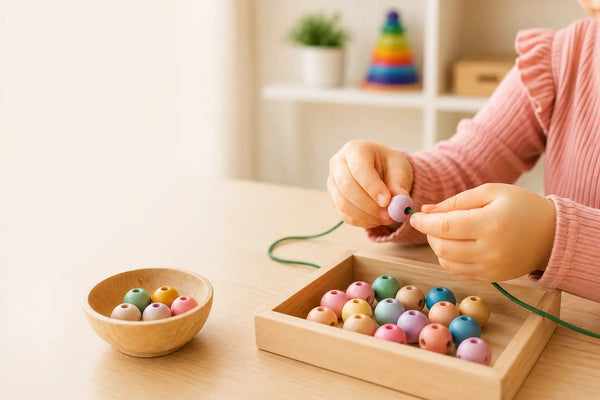
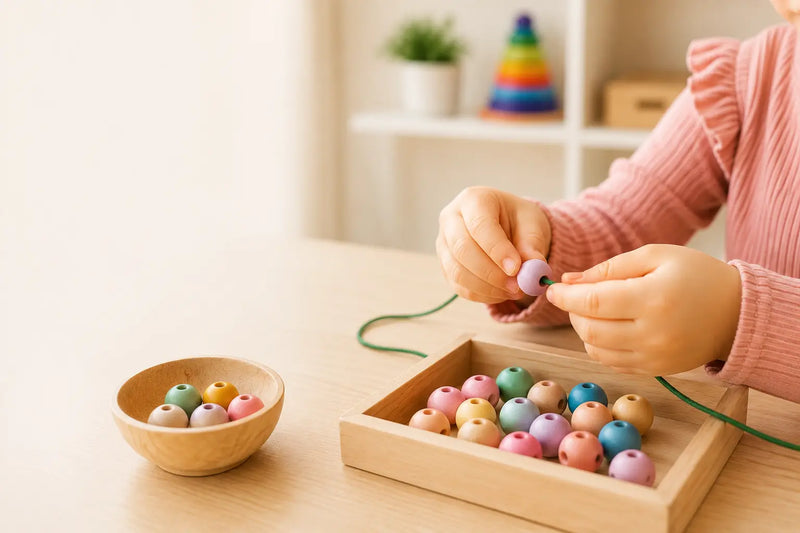
- Threading and lacing (3–4 years). Pasta on dry spaghetti, beads on a shoelace, blocks on a string. The Montessori Lacing Beads & Seesaw Balance combines threading with balance play.
- Cutting with child-safe scissors (3+ years). Start with snipping paper into strips, then cutting along straight lines. See the full progression in scissor skills by age.
- Sorting, matching and patterning (3–5 years). Colour, shape, size. The Montessori Wooden Shape & Colour Sorting Toy builds the visual side of fine motor; the Wooden Matching Puzzles add a matching layer.
- Playdough and clay (3+ years). Rolling, pinching, pressing small beads into balls. Playdough builds hand strength, finger isolation and bilateral coordination at the same time.
- Quiet books and busy books (3–5 years). Buttoning, zipping, Velcro, buckles — real self-care skills wrapped in play. The Montessori Quiet Book Giraffe and the Ultimate Montessori Busy Book cover a wide range of fastening skills.
- Tweezer and tong games (3.5+ years). Picking up small objects with tweezers or sugar tongs is excellent in-hand manipulation practice. The Drop or Not Tower turns this into a game of precision and patience.
- Magnetic maze boards (3.5+ years). Moving a magnetic pen through a maze builds a sustained, deliberate pincer grip. The Montessori Magnetic Maze Board is a good fit for this age.
- Two-handed construction toys (4–5 years). Building with both hands — magnetic tiles, geometric nail boards — refines bilateral coordination. The Rope Logic Challenge Game adds a puzzle layer to the same skill.
If an activity feels like a struggle, stop. Many preschoolers (and parents) lose the joy of an activity when it becomes a battle. Step away, try again tomorrow, or swap to a different material — dry pasta instead of fresh playdough, large beads instead of small ones, a marker instead of a pencil. Enjoyment and confidence are the foundations that later mastery is built on.
Accessibility tip: for children with low hand strength, motor planning difficulties or fatigue, use thicker crayons (the chunky triangular type), larger beads, wider paper, seated rather than standing setups, and longer warm-ups before fine work (3–5 minutes of hand play first). Many children also benefit from a hand-over-hand demonstration the first time they meet an activity, then independent practice.
✅ Signs you're ready to progress
- Your preschooler cuts along straight lines with reasonable accuracy, and is starting to attempt curves.
- They hold a pencil with any functional grip and can copy simple letters or shapes.
- They manage buttons, zips and lunchbox clips with only occasional help.
When these appear, your child is ready for the early school-age activities in the next section — sustained construction, complex scissor cutting, and the start of handwriting practice.
🩺 Occupational Therapist Insight
"More pencil practice" is rarely the answer at preschool age. The work that pays off most is shoulder and hand strength — climbing, carrying, playdough, threading. A child whose hands are stronger often starts writing more easily when the time comes, without needing a single extra worksheet.
🌱 This week's focus
- Add 10 minutes of playdough per day. Rolling sausages, making small balls, pressing beads into dough.
- Set up a threading station — pasta on dry spaghetti or beads on a lace.
- Try child-safe scissors if your child isn't yet: even snipping paper strips builds the open/close motion they'll need for cutting along lines.
Activities for early school age 5–8 years
What to try today: bring out a construction toy that takes 10–15 minutes to complete — a magnetic tile build, a geometric nail board, a more complex puzzle. Sit beside your child but don't direct. Watch how they plan, fail, adjust, retry. That whole cycle is fine motor under cognitive load.
Early school age is where fine motor shifts from "preparatory" to "functional". The hand is now ready for refined tool use — pencils for handwriting, scissors for complex cutting, cutlery for everything from sausages to spaghetti — but the underlying hand strength and bilateral coordination are still developing. Hand development in children at this stage is less about new movements and more about refining and automating the ones already in place. Fine motor milestones by age at this point are mostly about fluency — writing becomes automatic, scissor cuts become reliable, and tool use stops taking conscious effort. School readiness fine motor skills are now the foundations for handwriting fluency, classroom craft and self-care independence.
Six activities to try across ages 5–8. Typical sessions run 20–30 minutes for sustained construction or craft projects.
- Construction kits (5–7 years). Magnetic tiles, rods-and-balls kits, geometric nail boards. The Magnetic Balls & Rods Sticks Set builds complex 3D structures with sustained pincer work. The Montessori Geometric Nail Board Set is excellent for refining a precise pincer grip.
- Maths and counting toys (5–7 years). Counting trains, number stacks, abacus-style games. The Colour Matching & Counting Game combines fine motor with early numeracy.
- Colour sorting with smaller objects (5–8 years). The Montessori Magnetic Colour Sorting Game and the Wooden Rainbow Sorting Balls work for both colour matching and early maths.
- Magnetic builders (5–8 years). Open-ended building that takes sustained planning. The MagnetiCube Builder is a great indoor project for 15+ minutes of focused fine-motor work.
- Self-care independence (5–7 years). Lacing shoes, buttoning shirts, opening packets, packing lunchboxes. These are the same muscles and grips as writing — just wrapped in everyday tasks.
- Handwriting practice — but only as the capstone (5–8 years). Daily handwriting practice has a place at this age, but as one of several fine-motor activities, not the main event. See the full guide in handwriting and pre-writing.
If an activity feels like a struggle, stop. Many early-school-age children (and parents) lose the joy of an activity when it becomes a battle. Step away, try again tomorrow, or swap to a different material — a simpler puzzle, a shorter session, a different toy. Enjoyment and confidence are the foundations that later mastery is built on, and a child who associates fine-motor activities with frustration will avoid them.
Accessibility tip: at this age, children who find sustained tabletop work hard often do better with movement between activities (a 10-minute session, a break, another 10-minute session), seated-on-the-floor options rather than a chair, and tasks broken into smaller steps. Some children also benefit from a visual checklist on a sticky note next to the work area.
✅ Signs you're ready to progress
- Handwriting is automatic enough that your child can think about the words, not the letters.
- Scissor cuts are accurate for shapes and angles without constant adult support.
- Self-care (buttons, zips, shoelaces) is fully independent or nearly so.
These are signs that the foundational fine-motor work has done its job — at this stage, the focus shifts from building new skills to refining fluency, with cursive handwriting, complex craft, and tool use (knives, kitchen tools, musical instruments) becoming the next chapter.
🌱 This week's focus
- Pick one construction toy that's a little beyond your child's current skill level — sustained challenge is where refinement happens.
- Hand over the lunchbox. Let your child open every clip, packet and container themselves for a week.
- Don't skip play for "extra handwriting". Play IS the practice at this age.
Handwriting and pre-writing: what actually works
What to try today: watch your child draw. Count the different grips you see in a single session — palmar, fist, four-finger, tripod. Most children move between several grips naturally, and that's not a problem.
Handwriting is the most-discussed fine-motor skill, but it sits at the end of a long developmental chain. Hand development in children for writing needs shoulder stability, wrist control, hand strength, finger isolation, in-hand manipulation, visual-perceptual skills, language, attention and memory all running at once. Working on pencil grip directly addresses only one of those — which is why direct grip training usually doesn't help.
Pre-writing activities — drawing, scribbling, painting, chalk on pavement, finger-painting — build the underlying skills far more effectively than formal tracing. A child who scribbles vigorously for ten minutes is doing more for their future handwriting than a child who traces five letters neatly.
Healthychildren.org (American Academy of Pediatrics) recommends that children not be pushed into formal handwriting instruction before they're developmentally ready — usually around age 5–6 — and that pre-writing play is the work to focus on before then. The Royal Children's Hospital Melbourne takes a similar position.
| Stage | Typical age band | What the grip looks like | How to support it |
|---|---|---|---|
| Palmar supinate | 12–24 months | Whole fist around the crayon, marks made with arm movement | Offer chubby crayons; don't "correct" the grip |
| Digital pronate | 2–3 years | Crayon held with fingers (thumb up), wrist turned | Continue varied drawing; try chunky chalk on pavement |
| Static tripod | 3–4 years | Three-finger grip with whole-arm movement (the hand doesn't move yet) | Drawing on vertical surfaces (easel, wall) to encourage finger movement |
| Dynamic tripod | 4–6 years | Three-finger grip with isolated finger movement; refined control | Standard pencils, varied paper sizes, short writing sessions |
| Mature dynamic tripod | 6–8 years | Refined, automatic, low-effort pencil control | Sustained handwriting practice; cursive introduction if appropriate |
Pencil grip is not a race. Many children reach the dynamic tripod by age 5, others by age 7, and both are within the typical range. The earlier stages of grip development are visible in the table above, and "skipping" a stage is uncommon — most children move through all five, just on different timelines.
Three pre-writing practices that pay off most.
- Drawing on vertical surfaces. Easels, walls, windows with washable markers. Drawing upright encourages finger and wrist movement rather than whole-arm scribbling.
- Painting with thick brushes and water. A bucket of water and a big brush on a fence or path is rich pre-writing practice — and it's nearly free.
- Playdough "writing". Rolling playdough into long thin snakes and shaping letters on a flat surface builds the same finger movements as writing.
🌱 This week's focus
- Set up a drawing station on a vertical surface — easel, window, fridge with magnets, or wall with painter's tape as a "paper" border.
- Try a bucket of water and a big brush outside on the fence or path.
- Skip the tracing workbook for now if your child is under 5 — pre-writing play is more valuable.
Scissor skills by age: a developmental roadmap
Scissor skills by age develop gradually across five stages: open/close motion (2–3 years), fringing (2.5–3.5 years), cutting straight lines (3.5–4.5 years), curves and corners (4.5–5.5 years), and complex cutting (5.5–7 years). Each stage builds on the one before, and starting with strips and shapes is usually easier than cutting straight lines.
What to try today: offer your child a strip of paper about 2cm wide and a pair of child-safe scissors. Show them how the scissors open and close. Even if they can't cut yet, the open-and-close motion is the foundation of every later cutting skill.
Cutting is one of the most complex fine-motor tasks a young child learns — it requires bilateral coordination (one hand holds the paper, the other operates the scissors), hand strength, in-hand manipulation, visual tracking, and cognitive planning all at once. The Royal Children's Hospital Melbourne and the American Academy of Pediatrics both note that scissor skills develop gradually across a wide age range.
| Stage | Typical age band | What the cutting looks like | How to support it |
|---|---|---|---|
| Open/close motion | 2–3 years | Snips paper (or air) without direction; whole-arm movement | Short practice with child-safe scissors; don't worry about paper yet |
| Fringing | 2.5–3.5 years | Makes small cuts along a paper edge, like a fringe | Strips of paper 2–3cm wide; praise the snipping, not the line |
| Straight lines | 3.5–4.5 years | Cuts along a straight line drawn on paper, with some wandering | Wide lines (1–2cm), short strips, supervised practice |
| Curves and corners | 4.5–5.5 years | Cuts simple curves, then shapes (circle, square) | Draw a simple shape; let your child cut along it without fixing mistakes |
| Complex cutting | 5.5–7 years | Cuts detailed shapes, angles, layered craft projects | Real craft projects; let your child manage the project themselves |
Two things that help scissor skills progress. Practice on strips and shapes rather than straight lines at first — fringing and cutting curves are easier for most children. And the right scissors matter: spring-assisted child-safe scissors reduce hand fatigue and let a child focus on the cutting motion rather than on opening the scissors.
Many construction toys double as fine-motor scissor-skill prep: the Drop or Not Tower requires picking up sticks with a precise pincer, and the Montessori Spinning Rainbow Tower uses the same finger movements as cutting.
🏠 Everyday household item vs. educational toy
A short comparison that shows why development comes first, products second.
| Skill to build | Everyday household item (free) | Optional educational toy upgrade |
|---|---|---|
| Pincer grasp | Dry cereal (puffs, Cheerios), sultanas, pegs | Montessori Lacing Beads & Seesaw Balance |
| Threading | Pasta on dry spaghetti, beads on a shoelace | Wooden Matching Puzzles |
| Sorting | Pompoms or buttons in a muffin tray | Wooden Rainbow Sorting Balls |
| Pouring & in-hand work | Measuring cups, dry rice, water in a jug | Bloom & Build Garden Set |
| Construction / pincer precision | Cardboard boxes, kitchen tongs, ice cube trays | Magnetic Balls & Rods Sticks Set |
| Self-care / fasteners | Real clothing with buttons, zips, buckles | Montessori Quiet Book Giraffe / Ultimate Busy Book |
| Scissor prep (pincer/pick-up) | Tweezers + cotton balls, pegs on a string | Drop or Not Tower & Pick-Up Sticks |
| Drawing / pre-writing | Pavement chalk, water + brush on a fence | Magnetic Tiles Building Set (free-play creativity) |
The right column is for families who want a more durable, curated version of an everyday material. It is not a requirement.
🌱 This week's focus
- Set up a 5-minute scissor station with strips of paper 2–3cm wide. Fringing counts, even if it doesn't look like a line.
- Use spring-assisted scissors if your child is 3+ and struggling with hand fatigue.
- Skip straight-line worksheets. Curves and shapes are easier and more satisfying.
Household activities that build fine motor
What to try today: pick one everyday task this week and let your child own it. Wiping the table, peeling a banana, sorting socks — each one is fine-motor practice disguised as chores.
Many of the highest-value fine-motor activities for children are already in your house. Everyday tasks combine hand strength, bilateral coordination, in-hand manipulation and visual attention at the same time, with the bonus that children are often deeply motivated by real work. The household is the richest fine-motor classroom most families already have.
| Household task | Primary fine-motor skill | Secondary skill | Typical age fit |
|---|---|---|---|
| Cooking: stirring, pouring, kneading | Hand strength, bilateral coordination | Tool use, attention | 2+ years |
| Peeling a banana / soft fruit | In-hand manipulation | Bilateral coordination | 2.5+ years |
| Sorting laundry by colour | Visual-perceptual matching | Sorting, categorising | 3+ years |
| Setting the table: cutlery, napkins | Sorting, placement precision | Counting, sequencing | 3+ years |
| Buttoning and zipping own clothes | In-hand manipulation, bilateral coordination | Independence | 3.5+ years |
| Watering plants with a small watering can | Hand strength, wrist control | Responsibility, patience | 3+ years |
| Wiping surfaces with a sponge | Grip strength, pressure modulation | Bilateral coordination | 2+ years |
| Gardening: planting, digging, picking | Hand strength, pincer grip | Sensory regulation, patience | 3+ years |
| Opening packets, lunchboxes, containers | In-hand manipulation, bilateral coordination | School-readiness self-care | 4+ years |
| Tying shoelaces | Bilateral coordination, sequencing | Independence | 5.5–7 years |
Some families ask whether cooking and household tasks count as "real" fine-motor practice. They do — usually more so than equivalent commercial toys, because motivation is higher and the movements are tied to a real outcome. WonderMinds Kids toys like the Little Chef Wooden Kitchen Utensils and the Bloom & Build Garden Set extend these activities with child-sized tools, but real spoons and real watering cans work just as well.
🌱 This week's focus
- Hand over one everyday task your child can do — wiping, sorting, stirring — and let them own it for a week.
- Skip the urge to "do it properly". Half-mixed pancake batter and unevenly sorted socks are still fine-motor work.
- Notice what they're practising. Watch the grip, the bilateral coordination, the concentration.
Classroom and preschool activities educators can use today
What to try this week: set up a "fine-motor station" in your classroom with three activities on rotation — one threading, one sorting, one cutting. Change the materials every few days to keep the novelty high.
Educators run tight schedules, so the most useful fine-motor activities are the ones that slot into existing routines. The list below works inside morning circle, transition times, free play and small-group rotations, and every activity is open enough to be accessible to a mixed-age group.
| Activity | Skill focus | Where it fits |
|---|---|---|
| Threading station (pasta, beads, shoelaces) | Bilateral coordination, in-hand manipulation | Free play, small group |
| Cutting station (strips, shapes, fringing) | Bilateral coordination, tool use | Small group with educator |
| Playdough table (rolling, pinching, letters) | Hand strength, finger isolation | Free play, transition time |
| Sorting and matching games | Visual perception, categorisation | Morning routine, math rotations |
| Construction kits (magnetic, blocks, nails) | Pincer grip, bilateral coordination | Free play, STEM time |
| Self-care routines (buttons, zips, lunchboxes) | Independence, school-readiness | Arrival, departure, meal times |
| Drawing on vertical surfaces (easel, window) | Finger isolation, pre-writing | Art area, outdoor play |
Printable: classroom observation checklist. Use the table below over a four-week window. Tick which skills each child demonstrates without prompting, where prompting helps, or where the skill is not yet emerging. This is observation, not assessment — the goal is to know what to support, not to label any child.
📋 Classroom fine-motor observation checklist (printable)
| Skill | Not yet | Emerging | Developing | Confident |
|---|---|---|---|---|
| Pincer grasp (small objects) | ☐ | ☐ | ☐ | ☐ |
| Bilateral coordination (one hand holds, other manipulates) | ☐ | ☐ | ☐ | ☐ |
| Cutting with scissors (snipping) | ☐ | ☐ | ☐ | ☐ |
| Cutting with scissors (along lines) | ☐ | ☐ | ☐ | ☐ |
| Pencil grip (any functional grip) | ☐ | ☐ | ☐ | ☐ |
| Threading beads or pasta | ☐ | ☐ | ☐ | ☐ |
| Self-care buttons/zips | ☐ | ☐ | ☐ | ☐ |
| Sustained tabletop attention (10+ min) | ☐ | ☐ | ☐ | ☐ |
Tip: print this page or copy the table into your planning folder. Re-check after four weeks — most children will have shifted at least one column on most rows.
Neurodiversity-affirming adaptations
What to try today: watch for the moment your child disengages from a fine-motor activity. The withdrawal point tells you more about their nervous system than their skill level — and it's where adaptations help most.
Fine motor doesn't develop in isolation. For children who process touch, sound, movement or attention differently, the same activity can be regulating for one child and overwhelming for another. A neurodiversity-affirming approach accepts the child's nervous system as it is and adapts the activity to suit, rather than trying to "fix" the child's response. Our sensory toys for calm and focus guide covers the regulation side of fine-motor work, and our sensory processing differences in autism guide covers the neurodivergent side. Both sit alongside the same fine-motor picture as hand strength and pencil grip.
Four adaptations that work across most neurotypes.
- Reduce sensory load. A quieter table, fewer competing objects, softer lighting. Children who are easily overstimulated often engage longer with fine-motor work when the environment is calm.
- Offer movement breaks every few minutes. Jumping, swinging, crashing into a cushion, or pushing against a wall. Movement re-regulates the nervous system and often improves the next attempt at a tabletop task.
- Provide fidget input during tabletop work. A small fidget in the non-dominant hand can support attention for children who need to keep their hands busy. The WonderCalm Pop Tubes, the Sensory Activity Fidget Board, and the WonderCalm Magnetic Rings are designed for this.
- Use a wobble cushion or move-and-sit option. A Sensory Wobble Cushion lets a child move while seated, which often improves both attention and postural stability.
For autistic children who avoid certain textures: start with one new material at a time, alongside familiar favourites. It's fine to use a tool (a plastic spoon, a craft stick) to explore playdough rather than touching it directly. Many autistic children prefer the visual planning stage of construction activities over the sensory side — that's still genuine fine-motor practice.
For children with ADHD: short sessions (5–15 minutes) often outperform long ones. Variety matters more than depth at any single sitting. Pairing fine-motor work with a movement-based reward (a walk, a bounce on a trampoline, a trip outside) often produces better outcomes than pushing through a long task.
For children with sensory sensitivities more broadly: messy play is optional, not required. Dry materials (beads, blocks, fabric) build the same fine-motor skills as wet materials (sand, water, playdough). Skip the activities your child genuinely dislikes and lean into the ones they enjoy.
🩺 Occupational Therapist Insight
"Push through it" is rarely the right advice for neurodivergent children. The right advice is to adapt the activity, change the sensory environment, or shorten the session — and to recognise that the child's avoidance is usually communication, not defiance. Once the sensory load matches the child's window of tolerance, fine-motor skills often progress faster than they would under pressure.
🌱 This week's focus
- Notice the withdrawal point in one activity this week — when does your child disengage?
- Adapt one activity for sensory load, movement, or attention, and see if engagement improves.
- Skip the activities your child dislikes. There's always another route to the same skill.
Common mistakes that hold fine motor back
What to try today: pick one item on this list and notice whether it's happening in your home this week. If so, choose one gentle change.
Most fine-motor "delays" aren't caused by what parents are doing — they're caused by which supports aren't there yet. A few patterns are worth naming, because they're easy to slip into and they slow things down.
- Over-relying on worksheets. Worksheets train one specific skill — pencil control — and do little for hand strength, bilateral coordination or in-hand manipulation. A child who is asked to do worksheets before the foundational skills are ready usually starts to dislike drawing, not improve at it. The earlier sections of this guide cover what to do instead.
- Correcting pencil grip before the hand is ready. Children move through grip stages on their own timeline. Forcing a tripod grip at age three often leads to hand fatigue and avoidance. Let the grip follow the underlying strength and stability.
- Skipping the floor-play foundation. A child who hasn't spent enough time crawling, climbing and balancing will struggle with posture at the table. The fix is more floor play, not more sitting practice.
- Replacing hands-on play with screen-based fine-motor apps. Our guide to screen time and child development covers why hands-on play matters more than another app for fine-motor growth. Hands, textures and gravity do most of the work — and screens can't replicate that.
- Treating "talented" as fixed. Fine motor is one of the most trainable skill families in childhood. A child who struggles today can become a confident hand-user over months with the right kinds of practice. Many children with late-emerging pencil control go on to do very well at school.
- Doing too many activities at once. Five activities in rotation often produces less progress than one activity repeated often. Depth and repetition matter more than variety at the early stages.
- Pushing past frustration. If a child is consistently upset by an activity, the activity isn't the right fit. Step back, change the texture, change the duration, change the goal. A child's confidence with their hands matters more than another worksheet — joy and willingness come before mastery, not after.
🌱 This week's focus
- Notice one pattern from this list that shows up in your week.
- Make one small change. Add ten minutes of floor play. Drop one worksheet. Replace one screen session with hands-on play.
- Track what shifts — usually engagement changes first, skill follows.
How to track progress at home
What to try today: download or print the progress tracker below and pick one skill to observe this week. Just notice — don't teach.
Many parents want a way to know if their child is "on track" without turning every mealtime into an assessment. The tracker below gives a gentle structure: six skills, four progress levels, no scores. Use it over a four-to-six-week window — most children move at least one column on at least one row.
📋 Home fine-motor progress tracker (printable)
| Skill | Not yet | Emerging | Developing | Confident |
|---|---|---|---|---|
| Pincer grasp (small objects) | ☐ | ☐ | ☐ | ☐ |
| Bilateral coordination (one hand holds, other manipulates) | ☐ | ☐ | ☐ | ☐ |
| Cutting with scissors (snipping or along lines) | ☐ | ☐ | ☐ | ☐ |
| Pencil / crayon use (any functional grip) | ☐ | ☐ | ☐ | ☐ |
| Threading or sorting small objects | ☐ | ☐ | ☐ | ☐ |
| Self-care (buttons, zips, lunchboxes) | ☐ | ☐ | ☐ | ☐ |
Date first observation: ___ Date re-check (4–6 weeks): ___ Child's age: ___
What to do with the tracker. Look for shifts, not scores. If a row moves from "not yet" to "emerging", something is working — keep doing it. If several rows are stuck, the activities probably need a different setup (more floor play, shorter sessions, different materials). The when to seek support section covers when to ask for outside help.
🌱 This week's focus
- Print or copy the tracker and complete the first observation this week.
- Pick one row to focus on. Don't try to advance every row at once.
- Re-check in four to six weeks. Don't re-check daily — that's tracking, not parenting.
When to seek support: a parent's decision guide
What to try today: read this section once, then put it aside. Bring it back only if a question comes up — the goal isn't to scan for problems, it's to have a reference when one arises.
Most fine-motor differences are normal variation. A wide range of "typical" exists at every age, and many children who are slow to start with one skill develop it quickly later. The decision guide below distinguishes between typical variation and signs worth raising with a health professional.
Decision guide: typical variation vs. signs worth raising
| Usually within typical range | Worth raising with a GP or paediatrician |
|---|---|
| Doesn't use a tripod grip until 5–6 | No functional grip by 6–7, or avoids drawing entirely |
| Cuts slowly or unevenly at 4–5 | Cannot open and close scissors at 5+ |
| Drops small objects occasionally | Frequent dropping, strong hand fatigue, or pain with writing |
| Gets frustrated with detailed work | Avoids all drawing, writing and self-care tasks |
| One hand is consistently stronger | Strong hand preference before age 2, or any regression in skills |
| Slow at buttons and zips at 4–5 | Cannot manage large buttons or zip with help by 5–6 |
| Dislikes one or two textures | Avoids whole categories of textures, or strong distress with routine sensory input |
A note on regression. If a child loses skills they previously had — for example, stops drawing after previously enjoying it, or stops using words, or shows a marked change in coordination — that's worth raising promptly with a GP, regardless of which row it appears in. Regression is a different signal from slow development.
Who to see first
| Professional | When to start with them | What to bring |
|---|---|---|
| GP | First stop for any concern. They can rule out medical contributors and refer onward. | Your observation notes, plus any completed tracker |
| Paediatrician | If the GP refers, or if you have an existing developmental relationship. | GP letter, observation notes, family history |
| Occupational therapist (paediatric) | For specific fine-motor, handwriting or sensory concerns. Can assess and provide targeted strategies. | Tracker, examples of the activity your child finds hard |
| Child health nurse | Often the first practical contact — they can listen, observe, and suggest next steps. | Your questions, plus a short example of what you've noticed |
| Maternal & Child Health nurse (Vic) | For families in Victoria, free developmental consultations at key ages. | Your child's health record book |
What an OT fine-motor assessment looks like. The therapist watches your child play with a range of materials — beads, scissors, pencils, blocks, sensory items — and asks you about everyday routines. They'll write up observations and, if helpful, suggest a small set of targeted activities. Assessments are usually an hour, often less stressful for the child than parents expect, and the value is in the practical strategies, not the label.
🌱 This week's focus
- Decide your "first call" person. For most families, that's the GP or child health nurse.
- Write down two or three specific examples of what you've noticed — dates, what your child was doing, what you tried.
- Aim for "I'd like some guidance" rather than "I think my child has X" — clinicians often respond better to an open request.
Bringing it all together: a sample weekly fine-motor plan
What to try today: copy the template below into your diary or pin it to the fridge. Treat it as a starting point, not a checklist — adapt it to your child and your week.
This plan assumes a typical week with one or two children, mixed ages, and a mix of indoor and outdoor time. Most slots run 5–15 minutes. Skip anything that doesn't suit your week.
📋 Sample weekly fine-motor plan (printable)
| Day | Morning (5–15 min) | Afternoon (5–15 min) | Evening / outdoor |
|---|---|---|---|
| Mon | Threading station (pasta + dry spaghetti) | Playdough — rolling & pinching | Self-care: zipping own jacket |
| Tue | Sorting: pompoms by colour | Drawing on vertical surface (easel / window) | Bath-time pouring station |
| Wed | Kitchen help: stirring, pouring | Construction: magnetic tiles or nail board | Outdoor: chalk on pavement |
| Thu | Cutting station: fringing strips | Sensory: dry rice + scoop-and-pour | Tweezer transfer: cotton balls |
| Fri | Self-care: buttoning practice | Playdough letter shapes | Family board game (in-hand work for tokens) |
| Sat | Garden: planting, digging, watering | Open-ended craft: scissors + paper + glue | Open play: child's choice |
| Sun | Baking: stirring, measuring, rolling | Reading + drawing: child's choice | Reset for the week ahead |
Most slots use ordinary household items. Optional WonderMinds Kids upgrades are noted in the activity sections.
How to adapt this plan. Pick three slots a week you can commit to. Drop any slot that creates friction. Add outdoor or messy-play slots where the weather cooperates. Substitute freely — every line item is one route to the same skill. The plan is a scaffold, not a script.
Frequently asked questions
What to try today: read the questions that match your child's age or your current question. Skip the rest — come back when needed.
The questions below are the ones parents actually search for, plus the ones WonderMinds Kids customers ask most often. Ages and ranges are approximate guides — children develop at different rates.
Foundational questions
Age and milestones
Activities and home practice
Toys and products
School readiness and handwriting
Concerns and when to seek support
Final thoughts
Fine motor development is one of the most quietly powerful parts of early childhood. It builds the independence children feel in dressing themselves, the confidence that comes from "I did it myself", the everyday readiness for learning, and the writing fluency that supports every other school subject. And unlike many early skills, it is genuinely trainable — small, consistent changes across months make a meaningful difference.
If you remember nothing else from this guide, remember three things: start with the foundation — shoulder stability, hand strength, finger isolation — and the pencil grip will follow when the hand is ready; everyday activities are the most effective practice, and a child doing real work in the kitchen or garden is doing more for their hands than another worksheet; and enjoyment and confidence are the foundations that later mastery is built on, not the other way around.
If you've worked through the activity sections and the decision guide, you already have most of what you need. The rest is patience, repetition, and the willingness to let your child lead. Many children with late-emerging pencil control go on to do very well at school — and the parents who supported them were the ones who let them play.
References
- Raising Children Network (Australia). Fine motor skills: birth to 5 years, and beyond. Government-funded parenting resource. raisingchildren.net.au. Used for: age-banded activity guidance, tummy time foundations, child development framing.
- Royal Children's Hospital Melbourne — Kids Health Info. Developmental milestones, fine motor development, scissor skills. rch.org.au/kidsinfo. Used for: clinical-grade AU developmental references; pencil-grip progression framing.
- Healthdirect Australia. Child development and developmental milestones. healthdirect.gov.au. Used for: AU health information, when-to-seek-support pathways.
- American Academy of Pediatrics — Healthychildren.org. Developmental milestones and pre-writing guidance. healthychildren.org. Used for: international clinical reference, handwriting readiness, scissor skills progression.
- Centers for Disease Control and Prevention (CDC). Developmental milestones. cdc.gov/ncbddd/actearly/milestones. Used for: milestones-by-age reference framework.
- CanChild Centre for Childhood Disability Research, McMaster University. Hand skills and developmental frameworks. canchild.ca. Used for: OT-research framing of the five-stage building block sequence.
- American Occupational Therapy Association (AOTA). Hand skills development and school readiness. aota.org. Used for: school-readiness fine motor framework; pencil-grip progression.
- National Occupational Therapy Board of Australia (AHPRA). OT scope of practice and family-facing pathways. occupationaltherapyboard.gov.au. Used for: AU clinical pathways, when-to-seek-support framing.
- Kid Sense Child Development (AU). Fine motor development guide for parents. kidsense.com.au. Used for: AU parent-facing OT reference, developmental milestones framing.
- World Health Organization (WHO). Motor development in early childhood. who.int. Used for: international reference for typical developmental ranges.
This article is for general information. It is not a substitute for professional medical, occupational therapy or developmental advice. If you have concerns about your child's fine motor development, please consult your GP, paediatrician or a registered occupational therapist.