Most children find it hard to sit still, and that is usually a sign of healthy development rather than a problem to fix. Young children are still learning to coordinate movement, attention and emotion at the same time, and their bodies are built to move while their brains develop.[1] Sitting still for long periods is a skill that develops gradually and unevenly, and it depends as much on the environment, the task and how a child is feeling as it does on age.
If your child struggles to sit still at home, during homework, at preschool or at school, the more useful question is usually why is this hard for them right now, not what is wrong with them. This guide walks through what is happening developmentally, why some children move more than others, the sensory side of attention, and what tends to help in everyday life.
What "can't sit still" actually means
"My child can't sit still" usually covers four quite different behaviours, and they often need different responses.
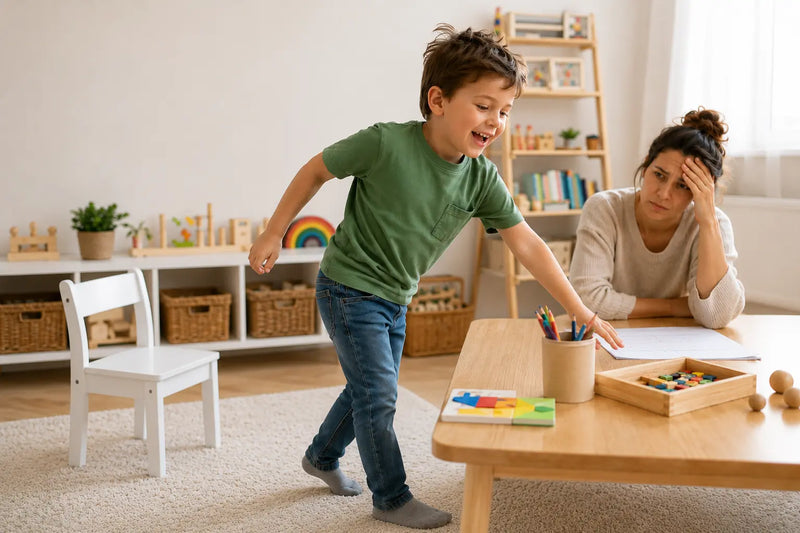
It can mean a child who fidgets, wiggles, taps fingers or bounces a leg while remaining at the table. It can mean a child who gets up repeatedly even after being asked to stay seated. It can mean a child who finds it hard to focus on a seated task, even when they want to. Or it can mean a child who seems in almost constant motion, jumping from one activity to the next with very little pause.
Each of these is its own thing. A child who fidgets with their hands while listening to a story is in a very different place from a child who can't stay in the chair for a board game. Mixing them up is one of the most common reasons parents end up trying strategies that don't fit what is actually going on.
It also helps to separate movement from attention. A child can sit still and still not be paying attention. A child can move constantly and still be deeply focused on what they are doing. Sitting still is not the same as learning, and movement is not the same as distraction.[2]
Once you can name what you are actually seeing — fidgeting, getting up, struggling to focus, or constant motion — the rest of this guide makes more sense.
Why children are designed to move
Children are not small adults who have forgotten to sit down. Their bodies and brains are set up to learn through movement, and movement is closely tied to how they think, feel and pay attention.
In the early years, the brain is wiring itself at an extraordinary rate. Movement is part of how that wiring happens. Crawling, climbing, balancing, spinning, running and stopping all feed information back to the brain about where the body is in space, how it is moving, and what is safe. This is why babies and toddlers rarely choose to sit still for long when they have the option to do something else.
Physical activity is also linked with the development of attention, memory and mood. The World Health Organization recommends that children aged 5 to 17 get an average of 60 minutes of moderate-to-vigorous physical activity a day, mostly through play.[3] For younger children, the recommendation is even simpler: move as much as possible through active play.
What this looks like in practice is that children often need to move before they can focus, not the other way around. A short burst of physical play — running, jumping, balancing, climbing — tends to settle the body so that a seated activity afterwards goes more smoothly. This is one of the most consistent findings in the research on young children's attention, and it is the basis for most of the strategies later in this guide.
Movement is also how children regulate emotion. Big feelings often come out through the body long before words are available. A child who is asked to sit still while they are frustrated, anxious, overstimulated or excited is being asked to do something their body is not yet able to do.
Why some children move more than others
Two children the same age can look completely different when it comes to sitting still. One will sit at the craft table for twenty minutes. Another will be up and down every few seconds. Both are developing normally.
There is no single reason a child moves more or less. Movement is the meeting point of temperament, sensory needs, energy level, sleep, hunger, mood, the task in front of them, and the environment around them.
A few patterns show up again and again:
- Some children are naturally more physically active. Activity level is part of temperament, the inborn style a child is born with. Active temperaments are not a problem to fix; they are a different starting point.
- Some children are seeking more sensory input. Movement, deep pressure and impact are reliable ways for the body to feel organised. Children who crave this kind of input will often find it themselves — by jumping, crashing into cushions, rolling on the floor, climbing, swinging.
- Some children are trying to down-regulate. For some children, movement is a way to settle an overwhelmed or under-aroused nervous system. The same behaviour can look like hyperactivity, but its purpose is the opposite.
- Some children are bored or under-stimulated. A task that is too easy, too repetitive, or pitched at the wrong level tends to push children into their bodies rather than the activity.
- Some children are tired, hungry, or coming down with something. Movement often goes up when children have less in the tank to regulate with.
Most children will move more in some of these situations and less in others. A child who can't sit still for morning tea at preschool but happily builds Lego for an hour at home is not being defiant at preschool. The two situations are asking very different things of their body and brain.
Recognising which of these is driving the behaviour on a given day is more useful than any single label. It also tends to point to a more accurate response — adding movement, reducing stimulation, changing the task, or waiting until they have eaten and rested.
The sensory connection: proprioception, vestibular and interoception
Movement and attention are wired together through the sensory systems. Three of these are particularly relevant to why some children find it hard to sit still.
| Sensory system | What it does | What it can look like when a child is seeking more input |
|---|---|---|
| Proprioception (body position sense) | Tells the brain where the body is and how it is moving, through feedback from muscles and joints. | Crashing into cushions, jumping off low steps, pushing heavy objects, squeezing into tight spaces, hugging tightly. |
| Vestibular (balance and movement sense) | Detects head position, balance, speed and direction of movement through the inner ear. | Spinning, swinging, rocking, climbing, hanging upside down, seeking out movement toys. |
| Interoception (internal body sense) | Senses what is happening inside the body — hunger, thirst, temperature, heart rate, the feeling of needing the toilet, the build-up of strong emotion. | Trouble noticing they need a drink, need to eat, need the toilet, or are getting frustrated until the feeling suddenly becomes too big. |
This table is a guide, not a diagnosis. Sensory needs exist on a wide spectrum, and most children move between seeking more input and avoiding it depending on the day, the environment and how they are feeling.
Proprioception and the "heavy work" idea
Pushing, pulling, lifting, carrying and crashing send strong proprioceptive input to the body. The activity is sometimes called "heavy work" in paediatric occupational therapy literature. It is also one of the most accessible tools parents have: a cuddle, carrying the groceries, jumping on a trampoline, or pushing a chair across the floor are all everyday examples.
Vestibular input and balance
Movement that changes the position of the head — swinging, spinning, sliding, climbing, rolling — feeds the vestibular system. Some children seek this input constantly; others find it overwhelming. Both responses are normal. The useful thing is matching the input to the child: a child who seeks movement may benefit from opportunities to do so, while a child who avoids it may need slow, predictable movement instead.
Interoception and the feelings inside
Interoception is the sense of what is happening inside the body — hunger, thirst, tiredness, the need to wee, heart rate, breath, the slow build-up of frustration or worry. Some children find this internal sense harder to read than others, and it is one of several developmental factors that can sit behind a child who can't sit still.
Sensory regulation vs hyperactivity: what's the difference
It is easy to read "won't sit still" as a single behaviour. In practice, two very different patterns often get labelled the same way.
One is sensory-seeking regulation: the child is moving in order to organise themselves. The movement is purposeful, and once the body is regulated, focus often arrives. These children tend to do better after they've had movement, and they often concentrate well during or right after physical activity.
The other is hyperactive behaviour: the child moves in many directions at once without an obvious organising purpose, finds it hard to stop once started, and has difficulty returning to a task even when they want to.
| Pattern | What it often looks like | What tends to help |
|---|---|---|
| Sensory-seeking regulation | Movement that builds up to a calm-down. Often involves heavy work, deep pressure, swinging or balancing. The child can often describe what they needed once they have it. | Planned movement breaks, heavy work, sensory tools (wobble cushion, fidget, balance play), a predictable rhythm of movement and seated activity. |
| Hyperactive behaviour | Movement that does not settle with sensory input alone. Difficulty stopping once started. Often present across many settings — home, preschool, grandparent's house, supermarket. | Environmental design, clear expectations, short tasks, movement between tasks rather than during, and a conversation with a health professional if it persists across settings or affects daily life.[4] |
Most children fall somewhere between these two patterns, and many move from one to the other depending on the day, the environment and how they are feeling.
The reason this distinction matters is that the strategies are different. A child whose movement is mostly sensory-seeking usually responds well to adding more movement, not less. A child whose behaviour fits the hyperactive pattern often needs environmental and routine changes alongside any movement strategy. Conflating the two tends to lead to advice that helps one child and not the other.
If you are not sure which pattern you are seeing, the most useful single question is this: does the movement build up to a calm-down, or does it keep going without one? That observation, recorded over a few days, is more useful than any checklist.
Does this mean my child has ADHD?
This is the question parents ask most often when a child can't sit still. Most of the time, no. Difficulty sitting still on its own is not the same as ADHD, and many children who can't sit still for long periods do not have ADHD.[4]
ADHD is a specific neurodevelopmental condition. In Australia, it is usually diagnosed by a paediatrician, child psychiatrist or psychologist after a careful assessment of a child's behaviour across multiple settings, over time, and against recognised clinical criteria.[4] It is not something a parent can diagnose at home, and it is not something a single behaviour — like not sitting still — can confirm or rule out.
This section is here to help you think about whether the behaviour you are seeing might be worth raising with a health professional. It is not a screening tool and it cannot tell you whether your child has ADHD.
Sitting still by age: what's typical and when to look closer
Sitting still is a skill that develops gradually, unevenly and at different rates in different children. There is no single age at which children "should" be able to sit still, and there is no standard number of minutes that marks "normal."[1]
What we can say with reasonable confidence is that:
- Babies and toddlers are not built to sit still for long periods. Their bodies and brains are still wiring themselves through movement, and asking them to be stationary goes against their development.[3b]
- Younger children typically engage with one activity for shorter stretches than older children, and they tend to switch more often. This is part of how young children explore, compare and learn.
- As children grow, the length of time they can stay engaged with an interesting task usually increases, but it remains strongly affected by interest, environment, hunger, tiredness, novelty and emotional state.[2]
- Even school-aged children and adults are not designed to sit still for very long stretches. Movement breaks help everyone concentrate, not just children who find it hard.
The table below describes what is often typical at different ages, and when a closer look might be worthwhile. It is a guide for thinking, not a checklist.
| Age | What you might notice about sitting and movement | Why this is often typical | When it may be worth a closer look |
|---|---|---|---|
| Under 1 year (infants) | Sustained sitting is brief or not yet happening. Movement is constant when the child is awake and well-rested. | Babies' posture, strength and balance are still developing, and they need frequent position changes. Floor-based interactive play is the WHO recommendation for this age.[3b] | If your baby seems unusually floppy or stiff, or is not meeting early movement milestones, your child and family health nurse or GP is the right person to talk to. |
| 1–2 years | Short bursts of focused play, then up and away. Squirming, climbing, walking or running at every opportunity. | At this age, the WHO recommends at least 180 minutes a day of physical activity at any intensity, including moderate- to vigorous-intensity activity, spread throughout the day.[3b] Long seated periods go against this developmental stage. | If your toddler rarely engages with any activity for even a short stretch, or seems constantly distressed by transitions, raise it with your child and family health nurse. |
| 3–4 years | Can sit briefly for a favourite activity but rarely for long. Switches between toys often. Wiggles, fidgets, may leave the table mid-meal. | The WHO recommends at least 180 minutes a day of physical activity, of which at least 60 minutes is moderate- to vigorous-intensity.[3b] Switching activities is part of how children this age explore and learn. | If movement is constant across every setting, or if preschool educators are also raising concerns about attention or behaviour, a conversation with your GP is worthwhile. |
| 5–7 years | Can stay seated for longer stretches of an interesting activity, but still needs movement breaks. Sitting still during meals or in the classroom is starting to be expected. | Most children this age can focus for longer when interested, but attention is still developing. Movement remains an important part of how this age learns and self-regulates.[3c] | If your child is unable to settle for any meaningful activity even one-on-one with you, or if school is regularly contacting you about behaviour or attention, raise it with your GP. |
| 8+ years | Most children can manage longer seated tasks, but they still benefit from movement breaks. Difficulty may show up more in homework or formal settings than in free play. | The capacity for sustained attention grows through the primary school years, but interest, novelty, sleep and emotional state continue to shape how long a child can stay with a task.[2] | If homework time is consistently a battle, if teachers raise ongoing concerns about focus or impulse control, or if your child's friendships are affected, an assessment is worth considering. |
A few things to keep in mind when reading this table:
- There is a wide range of typical. A child who seems "further along" or "behind" in one row is not necessarily ahead or behind in development overall.
- These patterns describe general trends. A child's individual temperament, sensory needs, environment and the demands placed on them all matter as much as their age.[1]
- The "when to look closer" column is not a diagnosis. It is a prompt to have a conversation with a health professional, who can help you understand what is happening for your specific child.
Children with developmental or neurodevelopmental differences may follow a different pattern. Children with autism, for example, may find sitting still especially hard in overstimulating environments and may need different supports. Children with developmental coordination disorder may find some motor tasks harder than others. None of this is a problem to fix — it is information about what kind of support your child might benefit from.[4]
What actually helps: 7 practical strategies to try
The strategies below are practical options to try, not prescriptions. They are about shaping the day so the body has what it needs — practical adjustments to environment, routine, task and movement, rather than demands on the child.
They are starting points drawn from what Raising Children Network, paediatric occupational therapy practice and the broader child development literature describe as practical approaches for active children. What fits one family may not fit another.
1. Movement before and during seated tasks
A short burst of physical play before a seated task — running, jumping, climbing, balancing, throwing and catching — is a practical way to set up the body for what follows. The CDC lists improved attention and memory among the benefits of physical activity for children.[3c] In practice this might look like some active play before homework, a walk or scoot home from school before afternoon reading, or a quick movement break between two seated activities. There is no single right amount — start with what fits your day and adjust from there.
For most children, attention comes in waves rather than as a steady stream. Short movement breaks at regular intervals — getting up, jumping, balancing on one foot, walking to the kitchen and back — are a practical way to break up longer seated tasks. For younger children, the rhythm might be "play, then sit briefly, then play again." For school-aged children, it might be a block of focused work, then a short break, then back to it. The exact timing matters less than the consistency of the rhythm.[1]
2. Create a calm, predictable environment for seated tasks
The environment shapes what a child notices, and small changes to it can make seated tasks easier to engage with.
- Reduce visual clutter on the table or in the room.
- Reduce competing noise where possible — turn off background TV, choose a quieter corner of the house.
- Make sure the chair and table are the right size. A child whose feet don't reach the floor, or who is hunched over a table that's too high, will find it harder to focus on the task rather than the discomfort.
- Keep water and a small snack within reach. Thirst and hunger are among the most common reasons a child can't settle.[2]
4. Offer sensory tools that match the child
Some children concentrate better when their hands are doing something. Chewing gum, a fidget, a small textured object, a wobble cushion, a resistance band around the front chair legs — these are all things parents and educators have found useful. What works is highly individual. A tool that helps one child focus may distract another.
The principle is not "every child needs a fidget." The principle is: if your child seeks movement, give them a small, acceptable way to do it during seated tasks. If they don't, don't introduce one.[1]
5. Replace "sit still" with better coaching
"Sit still" is one of the least useful instructions to give a child who is struggling to sit still. It does not tell them what to do instead, and it often makes the underlying frustration worse.
More useful alternatives, depending on the situation:
- "Feet on the floor, hands in your lap, eyes on me" — concrete and observable.
- "Five more minutes of this, then you can [run/jump/stretch]."
- "Show me a strong listening body." — invites the child to find their own version of "ready."
- "Let's stand up for this bit." — sometimes standing or moving while listening is fine.
What matters most is that the child knows what is expected, and that the expectation is achievable for their age and developmental stage.[2]
6. Match the task to the child's interest and stage
A child who can build Lego for an hour but can't sit through five minutes of handwriting does not have a "sitting still" problem. They have a mismatch between the task and their interest or developmental stage. Sometimes the right response is to change the task, not to push harder on the sitting.
This doesn't mean avoiding every difficult thing. It means noticing which tasks the child can settle into and which they can't, and asking what is different about each.[1]
7. Look after sleep, food and connection first
Before trying any new strategy, check the basics. A child who is sleep-deprived, hungry, thirsty, lonely or stressed will find it harder to settle, regardless of what tools you offer.
This is not about being a perfect parent. It is about recognising that when nothing seems to work, the answer is often something simple that has been overlooked — a rough night, a missed meal, an off day at preschool, a big change at home.[2]
The seven strategies above are starting points. They tend to work better together than in isolation, and they tend to take a few weeks of consistent practice to show an effect. If you try them and nothing changes over a month or two, that is information too — see the section on when to seek professional advice below.
What to try during homework (without saying "sit still")
Homework is the place where "won't sit still" tends to cause the most friction, because it is the place where sitting still is most expected. A few practical adjustments can change homework time without changing the work.
Movement before homework, not after
A short burst of physical activity before sitting down — even 10 minutes — usually makes homework go more smoothly than jumping straight from the school bag to the table. A walk home, a scooter ride, a quick game in the backyard, or even a few star-jumps in the lounge room all count.[3c]
Split the task, not the attention
"Do your homework" is a vague instruction. "Write three sentences, then you can have a five-minute break" is a concrete one. Most children focus better when a task is broken into smaller, defined chunks, with short movement breaks between them.
A simple rhythm for primary-school homework that often works:
- 15–20 minutes of focused work
- 5-minute movement break
- 15–20 minutes of focused work
- Stop, even if the work isn't finished
For older children, the work blocks can be longer, but the principle is the same: shorter bursts with breaks are usually more productive than one long sit.
Where they sit matters more than how they sit
Many children focus better when they have some choice about where they work. The kitchen table is not the only option. A few alternatives worth trying:
- Standing at a kitchen bench or counter (especially for reading or listening tasks)
- Lying on the floor with the book propped up
- Sitting on a wobble cushion or exercise ball instead of a chair
- A quiet corner with a small desk, away from the main family traffic
What matters is that the position is comfortable enough that the child can think about the work rather than the discomfort.[1]
What they do with their hands
Some children can hold a pencil but can't hold still. Giving the hands something to do — a fidget, a small piece of blu-tack, a stress ball — can free up attention for the work. Not all children need this. The signal to introduce one is when the child is constantly picking up, putting down or fiddling with objects during seated tasks. If they aren't doing that, leave it alone.[1]
When to stop
If homework has become a daily battle that ends in tears for everyone, that is information. It may be that the work is too hard, too easy, too long, or pitched at the wrong time of day. It may be that something else is going on. Forcing through a fight every night rarely helps and often makes things worse.
A short note in the homework diary, a quick conversation with the teacher, or a chat with your GP if the pattern continues over a term is usually a more useful response than another long evening at the table.[4]
For more on concentration and learning, see our guide to improving a child's concentration — the strategies there overlap with these, but it goes deeper into how to set up the day for focus.
7 movement-rich activities to try this week
The activities below are starting points, not a curriculum. They are designed to be done with what most families already have at home or in the local park. Pick one or two, not all seven.
1. Animal walks
Pick an animal and the whole family walks like it across the room or down the hallway. Bear crawls, crab walks, frog jumps, kangaroo hops, snake slithers. Two to three minutes is plenty. The mix of balance, coordination and imagination is what makes this work.
Why it helps: combines heavy work with vestibular input and creative play. Good for the 5 minutes before a seated task.
2. Pillow or cushion balance course
Build a course out of cushions, pillows and rolled-up towels on the floor. Stepping from one to the next without falling off is the game. Make the course wider for younger children and narrower for older ones.
Why it helps: proprioception and balance work. Children who need movement before focus often settle faster after this kind of activity.
3. Heavy carrying
Give your child something appropriately heavy to carry — a small bag of rice, a basket of folded washing, a box of books. The task itself is the activity. Help only when asked.
Why it helps: heavy work is one of the most accessible forms of proprioceptive input, and many parents find it settles active children for a while afterwards.
4. Trampoline breaks
If you have access to a small indoor or outdoor trampoline, 5 minutes of bouncing between seated activities is often enough to reset. If you don't, a similar burst of jumping on the spot, bouncing on a therapy ball or even hopping up and down the hallway works.
Why it helps: vestibular input, plus a clear transition between two different kinds of activity. Children usually know when they need it.
5. Freeze dance
Put on music and dance. When the music stops, freeze in whatever position you're in. Anyone who wobbles is out. Last one standing is the winner. Vary the music — fast, slow, surprising — to keep it interesting.
Why it helps: combines movement, listening, impulse control and laughter. Useful at the end of the day when the whole family needs to move.
6. Throwing and catching
Throw a ball back and forth, gradually increasing the distance. Vary the size and weight of the ball. Add a rule — bounce once before catching, catch with one hand, take two steps before throwing back.
Why it helps: hand-eye coordination, regulation of force, and a predictable back-and-forth rhythm that many children find calming.
7. Unstructured outdoor play
Go to the local park, the backyard, the footpath. Climb, run, dig, throw leaves, balance on logs, roll down hills. The less structured the better. Children who have had 30–60 minutes of this kind of play before a seated activity often settle in a noticeably different way.
Why it helps: the most natural form of the kind of physical activity the WHO recommends for children under 5 and for older children and adolescents.[3][3b]
How to pick what to try
If your child is mostly a "needs to move before focus" child, the activities that combine heavy work and vestibular input — animal walks, pillow courses, heavy carrying, trampoline breaks — tend to help most.
If your child is mostly a "needs to move hands to settle" child, the more stationary activities with a hands-busy component — throwing and catching, freeze dance — are often better.
If you are not sure, start with the unstructured outdoor play. It is the closest to the way most children are built to move, and it almost always helps. You can build the more specific activities from there once you see what your child responds to.
Movement tools that help: practical products for active children
There is no product that "fixes" a child who can't sit still. Movement, regulation and concentration are not bought at a checkout. What some families find useful, however, are specific toys and tools that make the kind of movement, sensory input or hands-busy activity described in this guide easier to do at home, at preschool, or in the car.
The products below are not endorsed by research as a guaranteed way to improve focus. They are practical options that parents and educators often explore when a child is seeking a particular kind of movement or sensory input. Each one has been chosen because it does one of the things this guide talks about — gives the body proprioceptive input, vestibular input, a quiet way to keep hands busy, or a physical outlet for movement — rather than because it promises an outcome.
As with everything in this guide, what helps one child may not help another. If you are unsure whether a particular product is right for your child, your GP, paediatrician or child and family health nurse is the right person to ask.
Tools that give the body a physical outlet
Some children are looking for big, whole-body movement. A few practical options that give the body that kind of input at home or outside:
- Montessori Balance & Hop Stepping Stones — indoor or outdoor stepping stones that combine balance and coordination practice with movement. Useful for the kind of gross-motor play recommended in the activities section earlier in this guide.
- Sensory Balance Path Stones Set — a path of balance stones for active gross-motor play. A practical alternative to a climbing frame or playground for younger children.
Tools that keep hands quietly busy
Some children concentrate better when their hands are doing something. A few practical options to consider for seated tasks:
- WonderCalm Pop Tubes — small, colourful tubes that pop together and apart. Useful for keeping hands busy during seated activities. Most children find them engaging; some find them distracting, which is part of normal variation.
- WonderCalm Magnetic Rings — small magnetic rings that click together and apart. A quieter option for the same purpose.
- Sensory Stress Ball — a small mesh ball that can be squeezed in the hand. A simple, low-distraction option for older children during seated tasks.
Tools that work at the table or in the classroom
Some families find a few specific tools useful at the homework table or in the classroom chair:
- Sensory Wobble Cushion — an inflatable cushion that sits on a chair. Some children find it helps them stay seated and engaged during seated tasks; others find it too distracting. It is worth a try if your child is a "needs to move while sitting" type.
- Calm & Focus Sensory Kit — a small selection of hands-busy tools grouped together. Useful if you are still working out which specific tool your child responds to.
For a wider selection of hands-busy and movement tools, see our fidget toys collection or our focus toys for ADHD collection.
Tools that support active open-ended play
Open-ended construction and pretend play are among the most practical ways to combine movement, focus and creativity. A few options from our range that fit naturally here:
- 3D Magnetic Tiles — open-ended construction that can be done standing at a table, on the floor, or anywhere in between.
- Wooden Matching Puzzles — a focused seated activity that engages hands and attention.
What these products are not
No toy, cushion, fidget or kit on this page is a substitute for movement, sleep, food, connection or, where appropriate, professional support. If you have tried the strategies in this guide and something still does not feel right, the next step is a conversation with a health professional — not another product.
For more on choosing developmentally rich toys, see our guide to toys that build thinking skills. For more on sensory tools and movement for children with ADHD, see our sensory toys for ADHD guide.
When to seek professional advice
Most of the time, the patterns described in this guide are part of normal development, and the strategies earlier in this article will help over time. Sometimes, however, what you are seeing is a signal that a professional assessment would be useful.
This section is a thinking aid, not a diagnostic tool. It is here to help you decide whether a conversation with a health professional is worth having — not to tell you what the conversation will conclude.
Always worth raising, regardless of context
The following signs are worth raising with a GP, paediatrician or child and family health nurse at any age:
- A sudden or significant change in your child's movement, attention or behaviour that has no obvious explanation.
- Loss of skills your child previously had (for example, words they used to say, ways they used to play, or milestones they had reached).
- Any concern about your child's hearing, vision or physical development.
- Any concern about how your child is feeling — about themselves, their body, or their relationships with others.
Patterns worth checking, if they persist
The patterns below are common in many children and often resolve on their own. If they are persistent and are meaningfully affecting your child's learning, sleep, friendships or family life, they are worth raising with a health professional.[4]
- Constant movement across almost every setting — not just at home during difficult tasks.
- Difficulty staying engaged with any activity, even highly preferred ones.
- Strong, frequent emotional reactions that take a long time to settle and are affecting daily life.
- Ongoing concerns from preschool or school about attention, behaviour or learning.
- Persistent sleep difficulties that do not respond to small changes in routine.
Who to talk to first
In Australia, the right first conversation depends on your child's age:
- Babies and toddlers (0–3): your child and family health nurse is the right first stop. They see many children your child's age and can guide you to specialist support if needed.
- Preschoolers (3–5): your GP is the right first stop, often supported by what preschool educators are observing.
- School-age (5+): your GP is the right first stop, supported by what teachers are observing. The GP can refer to a paediatrician, child psychologist or child psychiatrist if an assessment is needed.
The Royal Children's Hospital Melbourne notes that you should take your child to see their GP "if you think they may be autistic" or if you have other developmental concerns.[7] Raising Children Network describes the GP pathway for ADHD assessment in Australia.[4]
What to bring to the conversation
It helps to come with notes. The GP, paediatrician or nurse will want to understand:
- What you are seeing, in your own words.
- When it started, and whether anything changed around that time.
- How often it happens, and in which settings.
- What you have already tried, and what happened.
- What preschool or school is observing (where relevant).
- Any family history of similar patterns.
You do not need to have answers to any of these before the conversation. The point of the conversation is to find out what is actually happening, together.
What this section is not
This is not a diagnostic checklist. Nothing in this guide can tell you whether your child has ADHD, autism, DCD, anxiety or any other specific condition — only a qualified health professional working with your child and your family over time can do that.
Seeking advice is not a sign of failure as a parent. It is one of the most practical things you can do when something does not feel right.
A simple Week 1 plan: introducing more movement at home
If you have read this far and are wondering where to start, this is a one-week plan you can adapt to your own family. There is no single right way to do this — the goal is to try a few practical ideas, see what works, and adjust. Treat each day as a suggestion, not a rule.
Week 1 — printable plan
Print this page or save it for reference. The box around the plan is set up so it prints cleanly on a single A4 page.
| Day | Morning focus (5 min) | Afternoon focus (5 min) | Evening note |
|---|---|---|---|
| Monday | Notice one thing your child does with movement today — wiggling, jumping, fiddling. No need to change anything yet. | Add one short outdoor play window — 10 to 20 minutes, your call. | What did you notice? |
| Tuesday | Before any seated task, try 5 minutes of active play. | Try one movement break in the middle of any seated activity. | What worked? What didn't? |
| Wednesday | Try one of the 7 activities from earlier — animal walks or pillow course are easy starts. | Look at where your child sits for homework. Try one small change (cushion, position, lighting). | One thing to keep, one to drop. |
| Thursday | Add a movement break to one routine that usually goes badly (mealtime, getting dressed, getting out the door). | Unstructured outdoor play for as long as your child wants. | Did the routine go differently? |
| Friday | Pick the strategy from the week that felt easiest. Use it again today. | Free play. Notice what your child chooses to do when there is no plan. | What did they choose? |
| Saturday | Family movement — anything from a walk to the park to a kitchen dance party. | Try one of the 7 activities together, or invent your own. | What did everyone enjoy? |
| Sunday | Rest, or one slow activity. Notice what is different about a quieter day. | Look back over the week. Pick the one or two things that worked. | What will you keep next week? |
There is no pass or fail here. Some days the plan will not work, and that is information too. The point of the week is to try a few things and see what fits your family.
If the week doesn't go to plan
Most weeks will not follow the plan exactly. That is normal. The plan is a starting point for noticing what works, not a test to pass.
If nothing in the week felt useful, that is also information. It may be that:
- The strategies need more time — change often shows up over weeks rather than days.
- The strategies are not the right fit for your child, and the next step is to adjust.
- Something else is going on that needs a different kind of support, and the section above on when to seek professional advice is the right next read.
Either way, the week is not wasted. Noticing what does not work is just as useful as noticing what does.
5 myths about children who can't sit still
There are a few things that get said about active children so often they start to feel true. None of them are supported by the evidence, and some of them can make things harder for children and families.
Myth: They just need more discipline.
Discipline in the sense of clear, calm, predictable boundaries is useful for every child. But discipline in the sense of "sit still because I told you to" is not the right response to a child whose body is asking for movement. The Royal Children's Hospital Melbourne and Raising Children Network both describe responding to a child's developmental needs — including movement needs — as a more useful approach than demands to override those needs.[7][4]
Myth: Good children sit quietly.
Good children come in every shape of body and brain. A child who is active, loud, curious, intense or full of energy is not a "bad" child, and a child who is quiet is not automatically a "good" child. The idea that sitting still equals goodness is a habit, not a truth, and it sets children up to feel ashamed of normal development.
Myth: Sitting still means they're learning.
Children can sit still and not learn anything, and they can move and learn deeply. Raising Children Network describes concentration as something that comes and goes in waves, and is shaped by interest, environment and the task itself, not by how still the body is.[2]
Myth: Constant movement always means ADHD.
Most active children do not have ADHD. ADHD is a specific neurodevelopmental condition that requires a careful assessment by a qualified professional. Difficulty sitting still on its own is not the same as ADHD.[4]
Myth: They'll grow out of it.
Some children do become better at sitting still as they grow. Others are still active, intense or movement-seeking into adulthood, and that is also fine. The right question is not "will they grow out of it" but "what support do they need right now, and what might they need later." For some children, a neurodevelopmental assessment is the right step, regardless of age.[7]
Frequently asked questions
Is it normal that my child can't sit still?
Yes, in most cases. Sitting still for long periods is a skill that develops gradually and unevenly, and depends as much on interest, environment and the task as on age.
The relevant questions are usually what is making this hard for them right now, is it happening in lots of settings, and is it affecting their learning, sleep or relationships. The age-by-age table earlier in this guide describes what is often typical at each stage.
At what age should children be able to sit still?
There is no single age. Sitting still is a skill that develops gradually, and the length of time a child can stay engaged depends as much on interest, environment, hunger, tiredness and emotional state as on age.
Babies and toddlers are not built to sit still for long. As children grow, the length of time they can stay engaged with an interesting task usually increases. See the age-by-age table for what is often typical at different ages.
Why does my child focus better when they're moving?
This is a very common observation. There are several possible explanations, and the actual reason is often different from one day to the next.
Some children find it easier to settle into a seated task after movement. For others, the answer is more about the environment, the task, or how they are feeling that day. Some children who find it hard to sit still can concentrate deeply when they are doing something they care about — building, drawing, playing. There is no single explanation, and the same child may need different things on different days.
Does not sitting still always mean ADHD?
No. Most children who find it hard to sit still do not have ADHD. ADHD is a specific neurodevelopmental condition, usually diagnosed in Australia by a paediatrician, child psychiatrist or psychologist after a careful assessment across multiple settings over time.[4]
Many other things can look like ADHD from the outside — sleep problems, anxiety, sensory processing differences, learning differences, or being out of sync with an environment that doesn't suit the child. An assessment is the way to find out what is actually happening. See the full section above.
How do I get my child to sit still during homework?
The strategies in this guide cover the practical options — movement before homework, breaking the task into shorter chunks, choosing where and how your child sits, and giving the hands something to do. Clearer instructions ("write three sentences, then you can have a five-minute break") are one option to try instead of the general "do your homework."
If homework has become a daily battle, that is information too — see the full homework section and the when to seek professional advice section.
What helps a child who can't sit still at school?
The same principles as at home apply — movement breaks, choices about where to sit, hands-busy options during seated work, and a teacher who understands what your child needs. A calm conversation with the teacher is often the right first step.
For ongoing concerns, your child's teacher may suggest a meeting that includes the school counsellor, the learning support team, or your GP. Our guide to improving a child's concentration covers the school side in more detail.
Are fidget toys actually helpful?
Fidget tools are one option some families and educators choose to try during seated tasks. They are not a substitute for movement, sleep, food or connection, and they do not help every child. Some children find fidgets more distracting than helpful.
If your child is constantly picking up, putting down or fiddling with objects during seated tasks, a fidget may be worth trying. If your child is not doing that, leave it alone.
Why does my child move constantly from one activity to another?
Switching activities is part of how young children explore, compare and learn, especially under about five. The goal is not to eliminate switching but to gradually lengthen the time a child spends with any one activity.
If a child is switching so often that they rarely engage with any activity, or if the pattern is persistent across many settings, see the when to seek professional advice section.
How long does it take to see improvement after changing our routine?
There is no standard timeframe. Different children respond to different strategies at different rates, and responses vary.
If you have tried the strategies in this guide and are not seeing the change you hoped for, or if your concerns persist, that is information worth discussing with an appropriate health professional — your GP, child and family health nurse, paediatrician or child psychologist, depending on your child's age.
Can a child who can't sit still still learn well?
Yes. Many active children are excellent learners. The strategies in this guide are designed to make seated learning easier for active children, not to make them less active.
If a child is struggling at school despite these adjustments, it is worth raising with the teacher and, if needed, with your GP.
Should I be worried about my child who can't sit still?
Worrying is rarely useful, but paying attention is. Most children who can't sit still are doing what children do, and the strategies in this guide are a good starting point.
If the patterns you are seeing are persistent across settings, or are affecting your child's learning, sleep or relationships, see the when to seek professional advice section.
Does screen time make it harder for my child to sit still?
Screen time and attention is a topic with its own dedicated evidence base and practical guidance, which is covered in detail in our screen time and child development guide.
For most families, screens are part of everyday life. The useful question is usually what balance of screen time and other kinds of play works for your family. There is no single answer, and what is reasonable depends on your child's age, your family's routines, and the kinds of content involved.
What types of play help children who need lots of movement?
Play that combines movement with engagement is a particularly natural fit for children who need lots of movement. That includes:
- Active outdoor play — climbing, running, jumping, balancing.
- Heavy work — pushing, pulling, lifting, carrying.
- Vestibular play — swinging, spinning, sliding, balancing.
- Open-ended construction and pretend play — especially play that involves whole-body engagement, like building a fort.
The seven activities earlier in this guide give specific examples of each.
When should I talk to a health professional?
See the full when to seek professional advice section. The short version: if your concerns are persistent and are meaningfully affecting learning, sleep, friendships or family life, a conversation with your GP is the right next step.
A final note
Most children who can't sit still are doing what children do. Their bodies and brains are still learning to coordinate movement, attention and emotion at the same time, and that learning happens through play, through relationships, through movement, and through the day-to-day practice of small, repeated adjustments by the adults around them.
None of the strategies in this guide are quick fixes. Some will fit your family, some won't. The ones that fit will probably need a few weeks of consistent practice before any change is visible. The ones that don't fit are worth dropping without guilt.
If you have read this far, you have already done one of the most useful things a parent can do — paid attention, and looked for a clearer way to think about what is happening for your child. That, more than any specific product or strategy, is the foundation everything else rests on.
If at any point in this guide something has raised a concern, the next step is a conversation with a health professional — your GP, child and family health nurse, paediatrician or child psychologist, depending on your child's age. Nothing in this guide is a substitute for that conversation when it is needed.
References and further reading
The sources below underpin the developmental and health claims made in this guide. Where a source is Australian, it is listed first; international sources follow.
Australian sources
- Raising Children Network. Physical activity: young children. Raising Children Network (Australia). raisingchildren.net.au/preschoolers/play-learning/physical-play/physical-activity
- Raising Children Network. Concentration and play: school-age. Raising Children Network (Australia). raisingchildren.net.au/school-age/development/physical-development/physical-activity
- World Health Organization. WHO Guidelines on Physical Activity and Sedentary Behaviour. Geneva: WHO; 2020 (ISBN 978-92-4-001512-8). Recommendation for children and adolescents aged 5–17 (verbatim): "Children and adolescents should do at least an average of 60 minutes per day of moderate- to vigorous-intensity, mostly aerobic, physical activity, across the week." who.int/publications/i/item/9789240015128
- World Health Organization. WHO Guidelines on physical activity, sedentary behaviour and sleep for children under 5 years of age (summary press release). Geneva: WHO; 24 April 2019. Recommendation for infants (under 1 year): "Be physically active several times a day in a variety of ways, particularly through interactive floor-based play; more is better." For children 1–2 years: "Spend at least 180 minutes in a variety of types of physical activities at any intensity, including moderate-to-vigorous-intensity physical activity, spread throughout the day; more is better." For children 3–4 years: "Spend at least 180 minutes in a variety of types of physical activities at any intensity, of which at least 60 minutes is moderate- to vigorous-intensity physical activity, spread throughout the day; more is better." who.int/news/item/24-04-2019-to-grow-up-healthy-children-need-to-sit-less-and-play-more
- Raising Children Network. ADHD: what it is and how to support children and teenagers. Raising Children Network (Australia). raisingchildren.net.au/preschoolers/development/behaviour/behavioural-challenges/adhd
- Centers for Disease Control and Prevention. Learn the Signs. Act Early. (CDC, US — published in collaboration with AU government and international partners). "From birth to 5 years, your child should reach development milestones" and "Track your child's development and act early if you have a concern." cdc.gov/ncbddd/actearly/index.html
- Royal Children's Hospital Melbourne. Autism — Kids Health Info fact sheet. "Different responses to sensory information" (verbatim); "if they are sensitive to sounds, they may find it hard to focus in a busy school classroom" (verbatim); "Take a neuroaffirming approach" (verbatim); "Autistic children have different learning and support needs" (verbatim). rch.org.au/kidsinfo/fact_sheets/Autism
International sources
- CanChild, McMaster University. Developmental Coordination Disorder. "Developmental Coordination Disorder (DCD) is a motor skills disorder that affects five to six percent of all school-aged children" (verbatim). canchild.ca/en/diagnoses/developmental-coordination-disorder
- Centers for Disease Control and Prevention. Health Benefits of Physical Activity for Children. "Improves attention and memory" (verbatim); also see CDC Classroom Physical Activity ("Improving their concentration and ability to stay on-task in the classroom. Reducing disruptive behavior, such as fidgeting, in the classroom." — verbatim). cdc.gov/physical-activity-basics/health-benefits/physical-activity-children.html
Web pages accessed August 2026.